

Top 5 Benefits of Fiber to the Desktop (FTTD) for Modern Networks
- Sep 11th 2026
For decades, twisted-pair copper cabling has been the go-to standard for local area networks (LANs). But as bandwidth requirements, connected devices, and network speeds continue to increase, organizations are rethinking traditional copper-based architectures.
As fiber technology becomes more familiar and cost-effective, fiber to the desktop (FTTD) is emerging as an attractive alternative to traditional copper-based network architectures.
An FTTD network extends fiber connectivity directly to end-user devices, offering advantages in bandwidth, reach, security, efficiency, and long-term scalability.
Let's take a closer look at five key benefits of fiber to the desktop and why organizations are considering FTTD for modern network deployments.
1. Higher Bandwidth Potential for Data-Intensive Applications
Twisted-pair copper cabling has traditionally been the standard for LAN connectivity, with Category 6A supporting 10 Gigabit Ethernet (10GbE) over distances up to 100 meters. While newer copper standards can support higher speeds over shorter distances, increasing copper bandwidth can require more specialized cabling, installation practices, and active equipment.
While 10 Gig is sufficient for many everyday business applications, technological advancements are requiring enterprises to transmit ever-increasing volumes of data. Applications such as virtual and augmented reality, high-end 3D animation, high-definition video processing, and advanced analytics are driving the need for greater bandwidth closer to the edge of the network. AI and other data-intensive applications are adding to this demand as more data is generated, processed, and transferred at the network edge.
Fiber cabling offers a solution with virtually unlimited bandwidth potential. Fiber transmits data over pulses of light that travel through optical fibers rather than electrical signals through copper conductors. Fiber is also immune to electromagnetic interference (EMI), helping maintain signal integrity in electrically noisy environments.
In fiber systems, pulses of light can use different wavelengths on a single fiber via wavelength-division multiplexing (WDM), which can dramatically increase bandwidth capacity. Fiber can also support progressively higher transmission speeds as transceiver technology advances, allowing organizations to upgrade network electronics without necessarily replacing the underlying fiber infrastructure.
2. Extended Reach Beyond 100 Meters
Twisted-pair copper cabling is typically limited to a maximum channel length of about 100 meters from the switch in a telecom room to end devices. However, modern digital environments and the growing number of connected devices often require connectivity in remote and expansive locations that are frequently beyond the 100-meter limit. Deploying new telecom rooms to connect these distant devices occupies valuable space and can be extremely costly, requiring additional equipment, cooling, power, labor, and maintenance.
Fiber optic cabling offers a cost-effective way to connect devices well beyond the typical copper distance limitation, enabling more centralized equipment locations and potentially fewer telecom spaces.
For example, OM4 and OM5 multimode fiber can support 10 Gigabit Ethernet over distances of up to 400 meters under standard specifications, while singlemode fiber can support 10 Gigabit Ethernet over much longer distances, depending on the optics and network design.
This extended reach is one of the most significant FTTD network benefits for large facilities, campuses, warehouses, healthcare environments, and other buildings where devices may be distributed across expansive areas.
3. Enhanced Network Security
Fiber is inherently resistant to certain types of electromagnetic interception because it does not radiate electromagnetic signals in the same way copper cabling does.
Copper cables emit electromagnetic fields that can potentially be monitored by sophisticated equipment. Fiber requires physical access to the optical cable to attempt a traditional physical tap, making some forms of passive interception more difficult.
When fiber is physically manipulated, even slightly, it can alter the characteristics of the light signals traveling through it. Specialized fiber monitoring and alarmed fiber solutions can detect these changes and identify physical disturbances along the cable. In fact, alarmed fiber solutions leverage this capability to detect anomalies along the entire length of a fiber. They can be used to establish NSTISSI 7003 protective distribution systems for secure pathways in sensitive government networks.
In addition, fiber’s greater reach, which reduces the number of required telecom spaces, can also mean fewer physical locations and network devices that need to be secured and maintained.
4. Greater Network Efficiency and Sustainability
Fiber offers significant advantages over copper in terms of network efficiency and physical infrastructure requirements. Its greater reach requires fewer telecom spaces, which can reduce operational maintenance and energy consumption associated with equipment, power, and cooling.
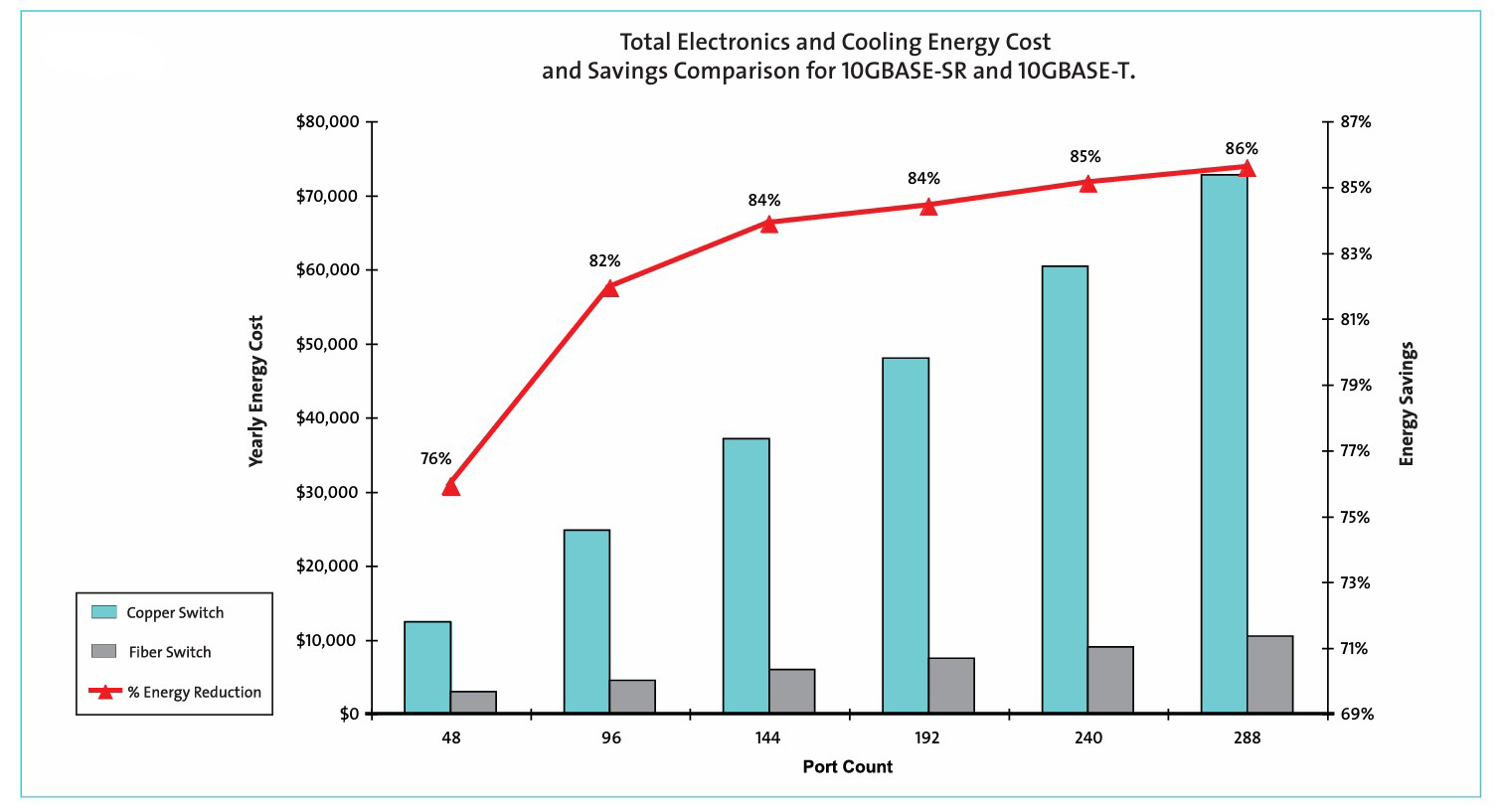
Fiber can also provide power-efficiency advantages at higher network speeds. According to Corning research, fiber-based networking solutions can reduce power consumption compared with equivalent copper configurations, depending on the network architecture and equipment used.
Fiber also significantly reduces overall material, space, and weight within a building compared to copper. Fiber cables are generally much lighter and smaller in diameter than comparable copper cables, offering improved density and reducing the amount of space required in racks, cabinets, pathways, and telecom spaces.
The smaller size and lower weight of fiber can simplify installation, increase pathway capacity, and reduce the physical infrastructure required to support a high-density network.
Fiber can also offer sustainability advantages because optical fiber is primarily made from silica, while copper depends on the extraction and processing of a finite metal resource. The overall environmental impact, however, depends on the materials, manufacturing processes, network equipment, installation, and lifecycle of the specific solution.
5. Future-Ready Infrastructure for Evolving Network Demands
One of the biggest benefits of fiber to the desktop is its ability to support network upgrades over time. Fiber’s virtually unlimited bandwidth potential can reduce the need for expensive, disruptive recabling as bandwidth demands increase.
An optical LAN infrastructure can support multiple generations of active equipment upgrades without requiring new cable installation. In contrast, copper infrastructure may need to be upgraded as network speeds and application requirements increase, particularly when existing cabling cannot support the desired speed or distance.
Next-generation Wi-Fi clearly demonstrates this future-ready approach. As Wi-Fi access points continue to evolve and require higher-speed uplinks, the cabling infrastructure connecting those access points becomes increasingly important. Fiber provides a high-bandwidth pathway that can accommodate future network upgrades without the same distance and bandwidth limitations associated with copper.
Fiber is also durable and resistant to many environmental factors that can affect copper cabling, including electromagnetic interference and corrosion. This reliability makes fiber a strong choice for stable network connections in noisy and harsh industrial, medical, marine, and military environments.
While the upfront cost of fiber optic active equipment is typically higher than that of copper, FTTD can provide significant long-term value by reducing cabling limitations, simplifying network expansion, and supporting future speed upgrades. When considering labor, materials, energy consumption, maintenance, and scalability, FTTD can be a cost-effective long-term network strategy,all while creating a more secure and efficient network.
Is Fiber to the Desktop Right for Your Network?
For organizations planning a new network or upgrading an existing LAN, fiber to the desktop offers a compelling alternative to traditional copper cabling. Its combination of high bandwidth, extended reach, improved security, efficiency, and long-term scalability makes FTTD a strong option for modern, high-performance network environments.
The good news is that Cables Plus is your trusted partner for FTTD deployments. Our full range of fiber solutions includes everything you need for flexible fiber connectivity deployments in the LAN, including our new versatile, compact High-Density FTTD Enclosures, available loaded and ready to deploy. Contact us today to speak with a Cables Plus expert about your FTTD deployment.