

A Guide to Fiber End Face Shape and Polish
- May 6th 2026

The overall shape and polish of a fiber end face dictate how light signals pass through a connector, directly impacting insertion loss and reflectance. Selecting the right connectivity requires a clear understanding of fiber end-face types and their compatibility—factors essential to maintaining network performance and uptime and preventing costly hardware damage. Let’s explore the evolution of fiber end-face technology and the critical considerations for today’s networks.
The Evolution of Physical Contact
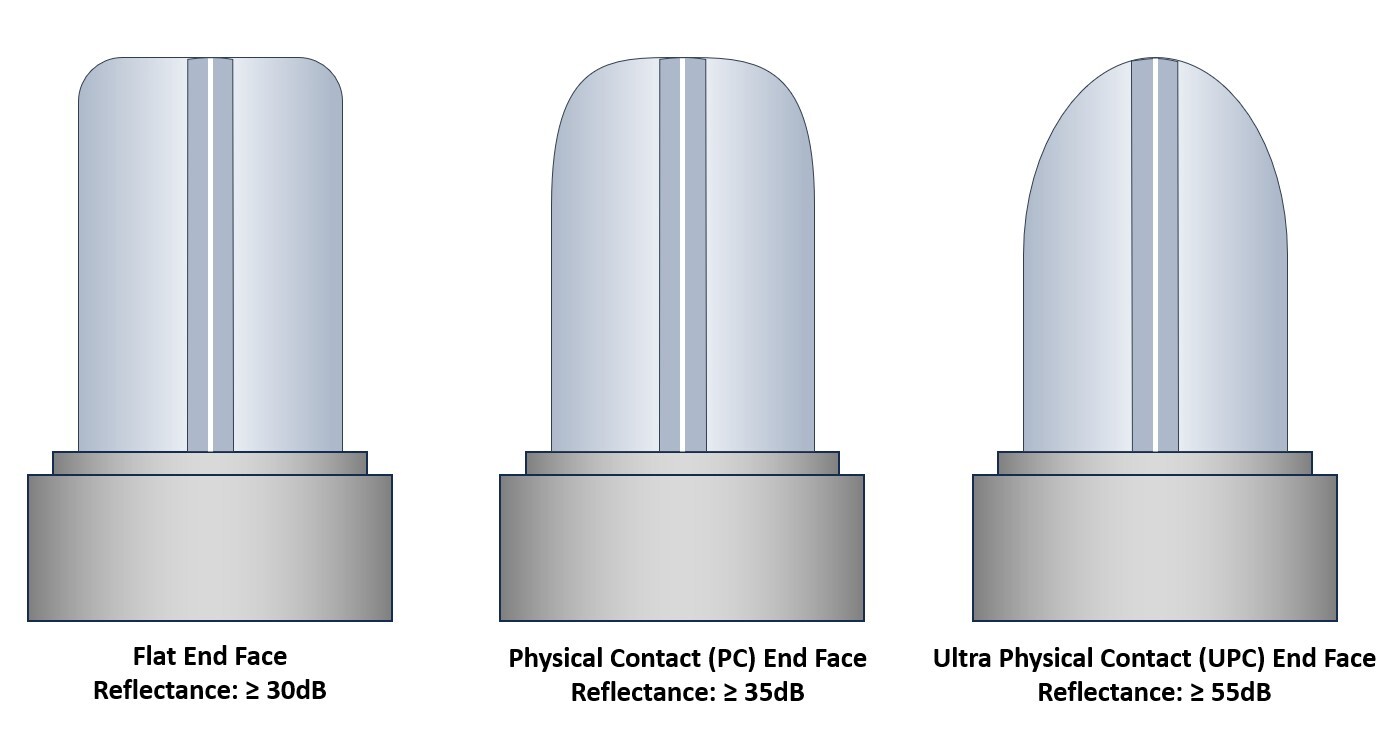
Early fiber connectors of the 1980s featured perfectly flat end faces. The truly flat surfaces of these connectors made it difficult to achieve proper contact without air gaps, leading to signal loss and high Fresnel reflections due to the refractive-index mismatch between the glass and air.
To overcome the high insertion loss and reflectance of flat end faces, engineers introduced Physical Contact (PC) fiber end-face technology in 1986. PC end faces were polished into a subtle convex shape, improving fiber core contact and significantly reducing reflections. It was the primary end-face type for SC, FC, and ST connectors at the time and was essential to early fiber-optic networking.
While better than flat-end faces, PC connectors still exhibited signal loss and reflections that impeded high-speed, long-distance light transmission. In response, the Ultra Physical Contact (UPC) end face, featuring a more pronounced domed convex surface, was developed to improve upon the PC. It became the dominant fiber end face throughout the 1990s and remains the primary end face for duplex 10 to 100 Gig multimode and singlemode indoor applications that don’t require long-haul distances.
The evolution from flat to PC to UPC fiber end faces significantly improved reflectance values. Reflectance, measured in decibels (dB), is the ratio of the light signal reflected from a connection point back toward the source relative to the input power. It’s expressed as a negative number, with values farther from zero indicating better performance. Flat fiber end faces typically had a reflectance value of -30dB or worse, while most UPC end faces exhibit a typical reflectance value of -55dB.
It’s worth noting that reflectance is sometimes confused with return loss, which is used to measure reflected power on an entire fiber link rather than just an individual connection. Expressed as a positive number, return loss is essentially the opposite of reflectance – it is the ratio of input power relative to the amount reflected. As with reflectance, values farther from zero indicate better return-loss performance.
The Angled Advantage
Around the same time that UPC connectors came on the scene, engineers also developed Angled Physical Contact (APC) connectors to address specific applications that required even better reflectance. APC connectors are polished at an 8-degree angle, which redirects reflected light into the cladding around the fiber core rather than straight back through the core to the light source. The result is an improved reflectance value of about -65dB. To distinguish between UPC and APC singlemode connectors, a blue connector body indicates UPC, and a green connector body indicates APC.
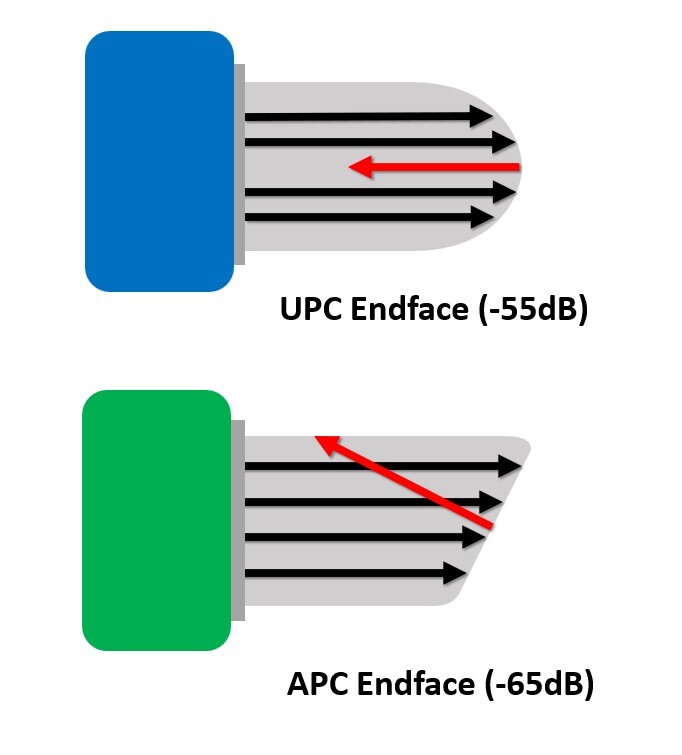
APC fiber end faces were initially developed for long-haul singlemode applications using higher-power laser modules, which are more sensitive to reflections. High reflectance can even cause these modules to overheat or malfunction. ACP connectors were later used for singlemode applications operating at longer wavelengths, particularly at 1550nm and above, which are more susceptible to reflections. Longer wavelengths are commonly used in wavelength-division multiplexing (WDM) applications that transmit signals over multiple wavelengths, as well as in applications that carry radio-frequency (RF) signals, such as video overlay in FTTX networks that require greater separation from data wavelengths. Consequently, APC connectors are the de facto interface in outside plant and FTTX deployments.
APC end faces are also the standard for singlemode multi-fiber connectors because it is nearly impossible to achieve sufficient reflectance across multiple UPC fibers. These include traditional singlemode MTP/MPO connectors and newer very small form factor (VSFF) SN-MT and MMC connectors, which is why they all feature a green connector body. The better reflectance performance of singlemode APC multi-fiber connectors is especially critical in high-speed, short-reach DR and FR applications, which leverage parallel optics (signals transmitted over multiple fibers) and cost-effective, lower-power lasers that are more susceptible to reflections.
APC multimode MTP/MPO connectors have also gained popularity for high-speed 400 and 800 Gig multimode applications that rely on parallel optics technology. PAM4 signaling used in these applications operates at 100 Gbps per lane and is more sensitive to reflection-induced noise. Several data centers have adopted APC 16-fiber multimode connectors for 800 Gig deployments and will do the same for 1.6 Terabit deployments.
Expanded Beam for Harsh Environments
Another type of connector end face is the expanded beam connector. Instead of direct physical contact, these connectors feature a molded spherical lens just in front of the fiber that expands and converges light signals travelling across a small air gap. This lens serves as the primary surface of an expanded beam connector and often features an anti-reflective coating to reduce reflectance.
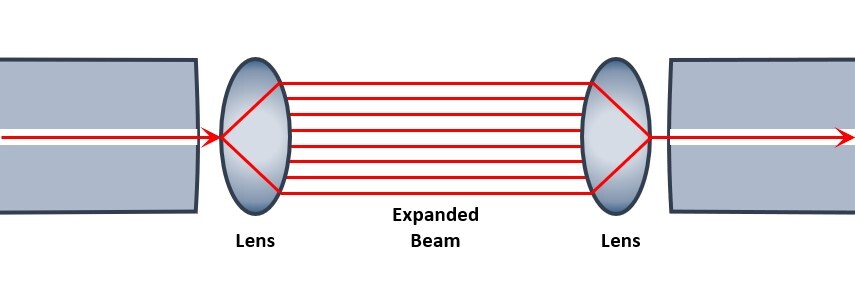
Because expanded beam connectors expand light signals and do not physically touch, they are highly resistant to contamination and can withstand a high number of mating cycles. Dust or dirt particles on an expanded beam connector block a much smaller percentage of light than on traditional UPC and APC connectors, and debris can be easily removed by washing with water.
While expanded beam connectors exhibit higher insertion loss than UPC and APC connectors, they are extremely beneficial in tactical military, outside broadcasting, mining, marine, and other harsh environments where dirt, moisture, high vibration, and frequent mating make standard UPC and APC fiber connectors impractical. Unlike MTP/MPO connectors, which are either pinned or unpinned, multi-fiber expanded-beam connectors are genderless, enabling easy daisy-chaining in field applications.
Essential Implementation Rules
When selecting fiber optic components, key considerations include the connector end face type. Two mating fiber connectors must have the same end-face type. In other words, a UPC fiber connector cannot mate with an APC fiber connector, and neither UPC nor APC can mate with an expanded beam connector.
Attempting to mate a UPC and an APC connector results in severe signal loss and high reflectance due to a large air gap between the fiber cores. Mating a UPC and an APC connector can also cause permanent physical damage, often resulting in scratches or breaks to the polished surfaces of both connectors. This is especially a concern for fiber end faces on the ports of expensive active equipment. If a connection is needed between a UPC and an APC end face, a hybrid UPC-to-APC jumper is used.
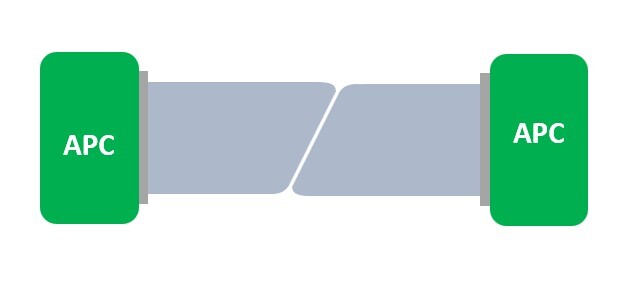
Another consideration with APC connectors is orientation. The 8-degree angle between two APC connectors must be properly aligned using keys/slots. Mating them in the wrong orientation creates an angle mismatch, leading to an air gap and potential physical damage to the connector tips. Mating APC MTP/MPO connectors requires a key-up-to-key-down configuration to ensure proper end-face alignment, which affects component polarity. While Method B polarity typically uses Type B adapters and a key-up-to-key-up configuration, APC connectivity requires “Modified Method B” polarity, using Type A adapters to ensure a key-up-to-key-down configuration.
The good news is that Cables Plus USA offers a wide range of connector types to suit your applications – from our full line of UPC and APC duplex, MTP/MPO, and VSFF connectivity for LANs and data centers to MIL-Spec TFOCA and IP-16 connectivity for tactical military and harsh oil, gas, and mining environments. Contact us today to speak with a Cables Plus USA expert about your connectivity needs.