

MPO/MTP vs. MT38999: Choosing the Right High-Density Multi-Fiber Connector
- Sep 28th 2026
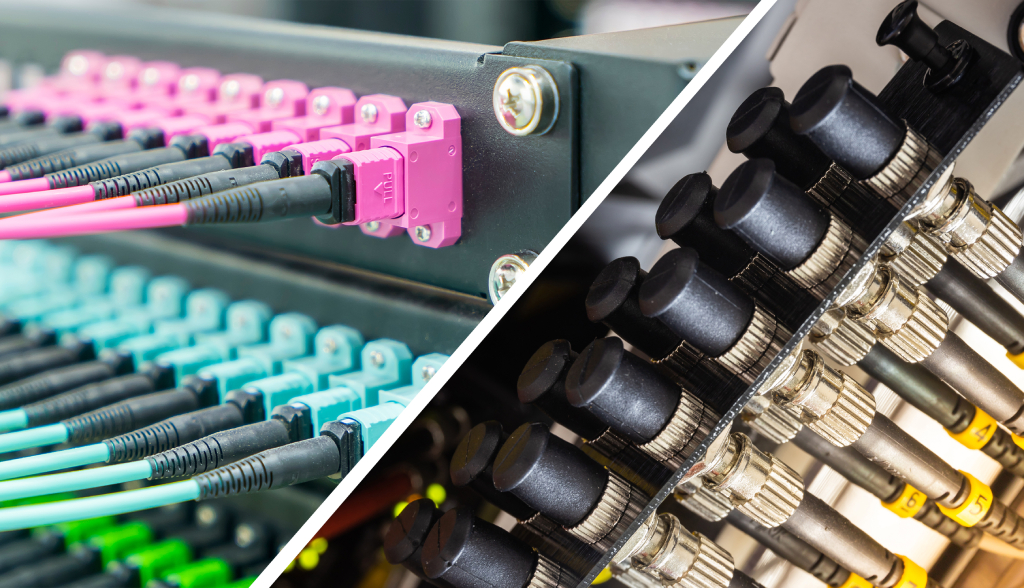
MPO/MTP and MT38999 multi-fiber connectors consolidate backbone cabling and support high-speed data transmission. However, these connectors serve vastly different operational environments and vary considerably in design, mechanics, durability, and fiber count. Let’s look at how MPO/MTP connectors compare to MT38999 connectors and how to choose the right one for your deployment.
Structural Design & Housing Mechanics
Both multi-fiber push-on (MPO) connectors—including the precision MTP variant from US Conec—and MT38999 connectors rely on the same high-precision, rectangular MT (mechanical transfer) ferrule. Measuring 0.25 in (6.4 mm) wide by 0.10 in (2.5 mm) high, the MT ferrule houses anywhere from 4 to 72 optical fibers in a compact array, with standard configurations holding 12, 16, 24, 32, 36, or 48 fibers.
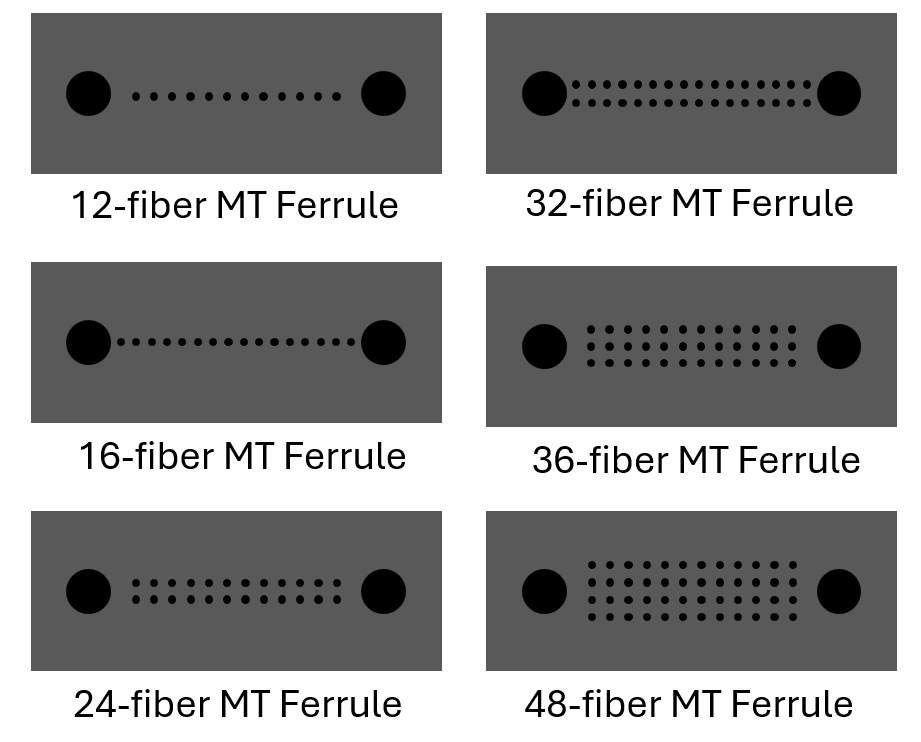
MT ferrules rely on micron-level precision and stringent endface geometry to maintain consistent polish angles and fiber protrusion heights across all fibers in the array. Fiber alignment is achieved via guide holes and pins—female connectors feature two guide holes that accept two metal guide pins on the male connector.
Beyond the MT ferrule, MPO/MTP and MT38999 connectors differ fundamentally in their outer mechanical design.
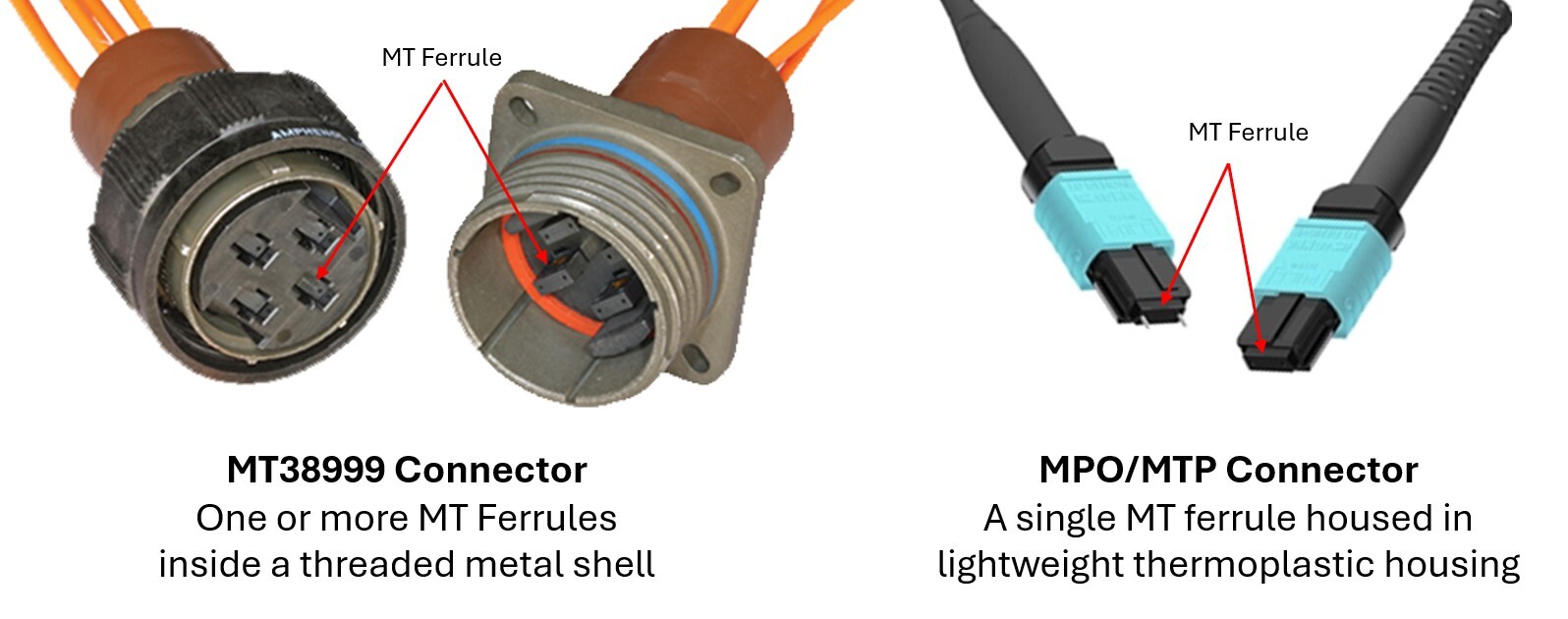
- MPO/MTP connectors: Feature a single MT ferrule inside a lightweight thermoplastic push-pull outer housing. A small internal spring applies constant pressure on the MT ferrule to maintain physical endface contact between mated connectors. An integrated key on the housing ensures proper orientation and polarity alignment, while a rear rubber or plastic strain-relief boot prevents the fiber cable from bending at the termination point. MPO/MTP connectors are almost always factory-terminated onto commercial trunk cables.
- MT38999 connectors: House one or more MT ferrules inside a heavy-duty metal shell (typically aluminum, stainless steel, or marine bronze) built to the military MIL-DTL-38999 Series III standard. Instead of a push-pull latching mechanism, the MT38999 uses a keyed threaded coupling mechanism that ensures proper orientation and locks securely with a quick 360-degree turn. MT38999 connectors often require specialized ruggedized fiber cabling by specialized harness manufacturers.
Environmental Durability & Ingress Protection
Standard commercial MPO/MTP connectors are engineered primarily for controlled indoor environments and have very low tolerance for physical abuse. Designed for rapid insertion and removal, MPO/MTP connectors click into place when pushed into a port or adapter. However, because they are non-locking, MPO/MTP connectors are susceptible to accidental disconnection. Strong mechanical vibrations can shift the alignment pins, degrading or completely impeding the signal.
Standard MPO/MTP connectors offer no inherent protection against moisture or dust ingress beyond basic plastic dust caps used when unmated. The thermoplastic housing can also degrade under UV radiation, harsh industrial solvents, and extreme temperature cycling.
In contrast, MT38999 connectors use a triple-start threaded coupling mechanism that locks mated connectors in place, preventing accidental disconnection from physical strain and extreme vibration. The MIL-DTL-38999 durable outer shell features integrated O-rings that establish an IP67/IP68 ingress rating to protect against moisture and dust. The outer shell also uses materials and platings designed to handle extreme temperatures and resist corrosion from salt spray, fuels, and industrial solvents.
Fiber Count & Spatial Density
MPO/MTP connectors house a single MT ferrule. While specialty ultra-high-density MT ferrules contain 48 fibers (4 rows of 12 fibers) or 72 fibers (six rows of 12 fibers), commercially available MPO/MTP connectors commonly use ferrules with 12, 16, 24, or 32 fibers.
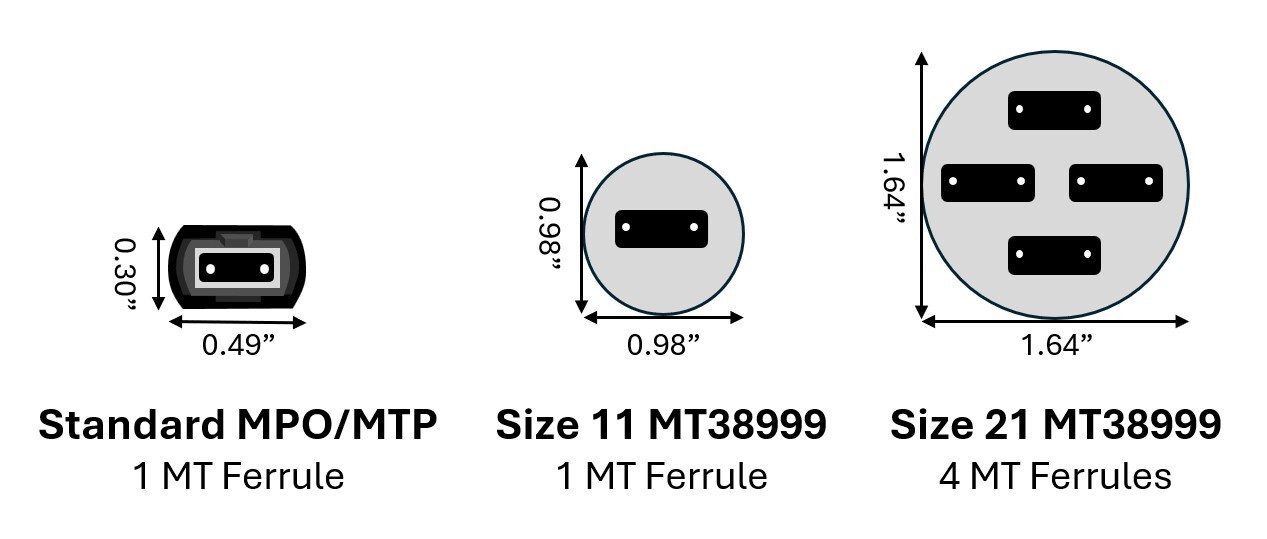
A standard MPO/MTP connector body is 0.49 inches (12.5mm) wide by 0.3 inches (7.6 mm) high. Very small form factor (VSFF) variants like the SN-MT or MMC maintain the MT ferrule but significantly reduce the overall housing to roughly one-third the size of a standard MPO for ultra-high-density environments.
MT38999 connectors house up to four MT ferrules and support up to 192 fibers. The MT ferrules used in MT38999 connectors typically contain 12, 24, or 48 fibers. MT38999 connectors are larger than standard MPO/MTP connectors because of their circular, threaded metal shell and ability to house multiple MT ferrules. The metal shells come in various sizes per MIL-DTL-38999 specifications, ranging from shell size 11 (single MT ferrule) with a 0.98-inch (25 mm) diameter to shell size 21 (four MT ferrules) with a 1.64-inch (41.7mm) diameter.
Optical Performance & Alignment Precision
While both standard MPO/MTP and MT38999 connectors rely on the same fundamental MT ferrule technology, their optical performance differs due to their overall design and target applications.
Standard MPO/MTP connectors rely solely on their endface geometry and MT guide pins to maintain fiber-to-fiber alignment. Their insertion loss typically ranges from 0.30 dB to 0.75 dB. However, because they are targeted primarily for advanced high-speed data center applications with stringent insertion loss requirements, MPO/MTP connectors are available in low-loss versions. Low-loss MPO/MTP connectors are manufactured with extremely tight tolerances to achieve an insertion loss of 0.20 dB or less.
MT38999 connectors feature a three-level alignment strategy, including shell-to-shell keying, insert-to-insert matching, and the MT guide pins. This superior alignment is especially critical for MT38999 connectors with multiple MT ferrules that must align. MT38999 connectors typically have an insertion loss of 0.3 dB. Since they are targeted for harsh environments, MT38999 connectors are optimized more for environmental stability than for minimal loss.
Both MPO/MTP and MT38999 connectors follow identical cleaning and inspection requirements and should always be inspected and cleaned if needed prior to mating. Both MPO/MTP and MT38999 connectors are keyed for proper orientation but must also be carefully deployed to maintain proper polarity, ensuring transmit signals at one end correspond to the receiver at the other. Without proper polarity, data will not flow.
Environment & Applications
Standard MPO/MTP connectors are a mainstay in modern high-density data centers, delivering space savings, fast plug-and-play deployment, scalability, and optimal performance from 10 to 800 Gig and beyond. They are the primary connector type for creating links between switches, servers, and storage devices, including high-speed connections between interconnected GPUs in AI clusters.
MPO/MTP connectivity is often leveraged to consolidate backbone cabling for duplex applications from 1 to 100 Gig. Instead of routing several individual duplex cables, MPO/MTP trunk cables connect to the rear of patch panels that break out to duplex connections at the front for connecting to switch and server ports. MPO/MTP connectivity is also essential for high-speed parallel optics applications where a single data stream is split and transmitted simultaneously across multiple fibers to achieve faster transmission speeds. For example, 8-fiber MPO/MTP connections can support 100 Gig, 200 Gig, and 400 Gig applications with 4 fibers transmitting and 4 receiving at 25, 50, or 100 Gb/s, while 16-fiber MPO/MTP connections can support 800 Gig with 8 fibers transmitting and 8 receiving at 100 Gb/s. MPO/MTP will also be the primary connector type for future 1.6 Terabit speeds and3.2 Terabit speeds.
Rather than controlled indoor data center environments, MT38999 connectors are deployed in severe, harsh environments where standard commercial MPO/MTP connectors would fail. They are the recognized standard for all military and commercial aerospace applications. MT38999 connectors can support the same transmission speeds as MPO/MTP connectors but are primarily used to aggregate multiple 1 to 100 Gigabit channels, often in long-distance, point-to-point backplane architectures linking mission-critical equipment.
MT38999 connectors create links for field command, control, and reconnaissance in military tactical field and defense applications and provide high-bandwidth connections across modern aerospace, avionics, marine, radar, and satellite systems. Their ingress protection and vibration and corrosion resistance also make MT38999 connectors ideal for high-speed data links in industrial automation, offshore drilling, heavy mining environments, and other harsh environments.
Which High-Density Connector is Right for You?
The primary factor for choosing between standard MPO/MTP connectors and MT38999 connectors is the environment. If you need to create high-speed fiber links in a controlled data center environment, MPO/MTP connectors are more than likely your best bet. But for high-speed links in any environment subject to mechanical shock, strong vibration, extreme temperature, or corrosive liquids or chemicals, MT38999 connectors are the better choice.
The table below outlines the key differences to help you choose the right multi-fiber connector.
|
MTP/MPO |
MT38999 |
|
|
Number of MT Ferrules |
1 per connector |
Up to 4 per connector |
|
Maximum Fiber Density |
32 fibers typical (48 or 72 specialty) |
196 fibers |
|
Overall size |
0.49 X 0.3 in. |
0.98 to 1.64 in. diameter |
|
Connection Method |
Push-pull, non-locking |
Threaded locking coupling |
|
Performance |
0.2 dB typical |
0.3 dB typical |
|
Ingress Protection |
None |
IP67/IP68 |
|
Corrosion Resistance |
Low |
High |
|
Shock/Vibration Resistance |
Low |
High |
|
Environment |
Controlled, Indoor Data Center |
Harsh Military, Outdoor, Industrial |
|
Standards |
Commercial Cabling Standards (TIA, IEC) |
MIL SPEC (MIL-DTL-38999 Series III) |
The good news is that Cables Plus USA is a premier partner for both standard commercial MPO/MTP connectivity and harsh-environment MTP38999 connectivity built to comply with the MIL-DTL-38999 Series III standard. Contact our team today to order custom fiber assemblies for your next deployment—from the data center rack to the military battlefield and everywhere in between.