

Network Transceiver Basics: From 1 to 800 Gig and Beyond
- May 21st 2026
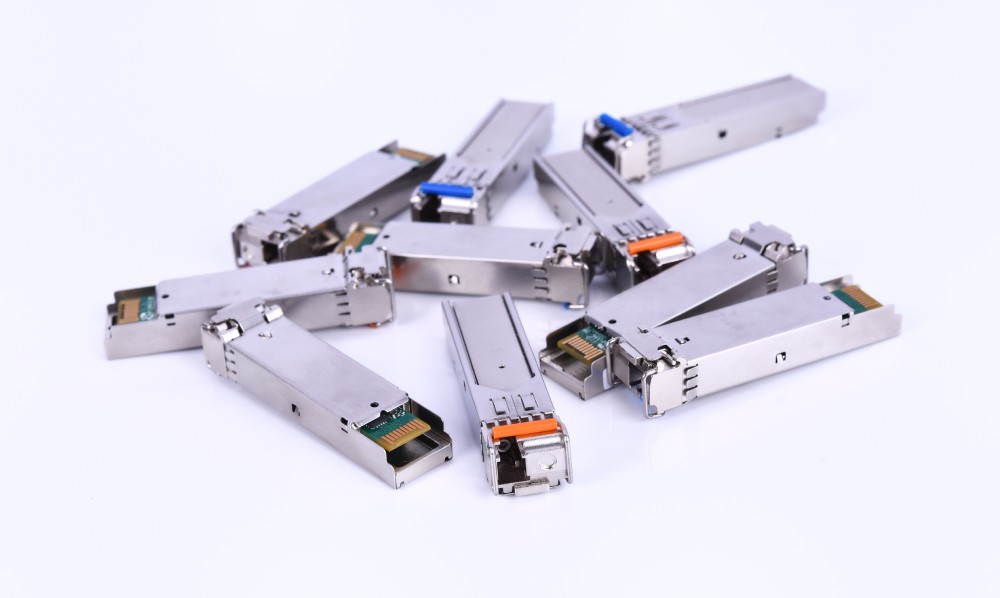
In networking, transceivers are critical components that include a transmitter and receiver for data transmission. While they can be embedded in direct-attach copper (DAC) and active optical cable (AOC) assemblies, hot-pluggable transceivers offer several advantages.
Hot-pluggable transceivers are used in active equipment, such as routers and switches, to support a variety of structured cabling applications in data centers, LANs, and WANs. They are available for copper twisted-pair applications up to 10 Gig and for multimode and singlemode fiber applications up to 800 Gig and beyond. They can be easily removed and replaced without powering down equipment or disrupting operations, facilitating fast and easy upgrades to any number of ports in a system.
Transceivers have advanced significantly over the past few decades alongside signal encoding, offering higher density and ever-faster transmission speeds to support high-bandwidth applications and immense consumer demand for data-intensive services. Let’s look at the most common fiber transceivers, how they’ve evolved, and how to choose the right transceiver for your application.
1 Gig Transceivers
Introduced in the 1990s, the Gigabit Interface Converter — GBIC — was the first hot-pluggable single-lane interface for 1 Gig speeds. It supports 1 Gig over twisted-pair copper cabling (Category 5e, Category 6, and Category 6A) up to 100 meters (m). For fiber applications, it supports 1 Gig over multimode up to 550 m and over singlemode up to 120 kilometers (km). Due to their larger size and slower speeds, GBIC transceivers are used primarily in legacy infrastructure and have been largely superseded by SFP transceivers.
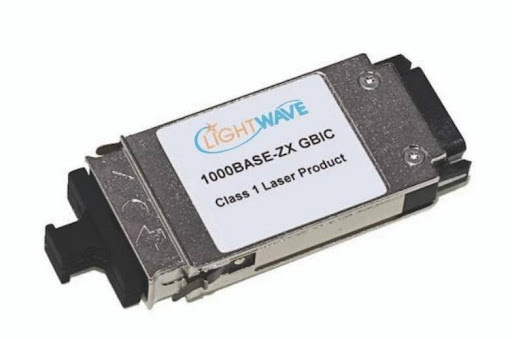
GBIC Transceiver
SFP transceivers, which stand for small form-factor pluggable, support the same applications as GBICs but have a much smaller footprint. In fact, they were often referred to as “mini-GBIC” when first introduced around 2001. Due to their smaller size, SFP transceivers enable higher switch port densities and are the de facto standard in modern 1 Gig networking applications.
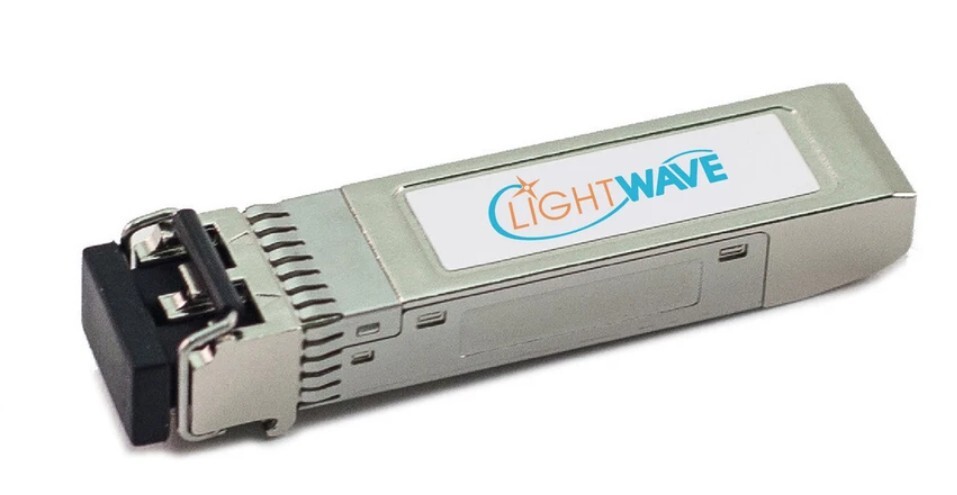
SFP Transceiver
Multi-Gig Transceivers
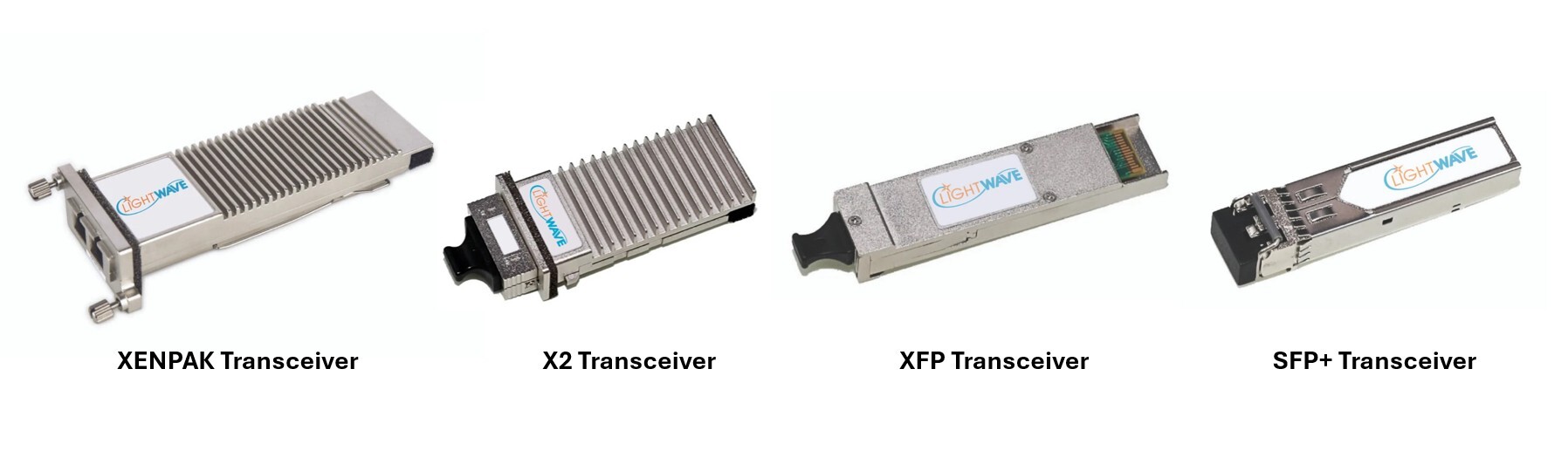
XENPAK fiber-optic transceivers were introduced in the early 2000s for single-lane 10 Gig applications, including up to 100 m over twisted-pair copper cabling, 400 m over multimode, and 80 km over singlemode. Introduced in 2002, the X2 functions the same as XENPAK but is approximately 50% smaller, improving switch port density. Currently, XENPAK and X2 transceivers are used in legacy 10 Gig deployments. Due to their larger footprint and high-power consumption, they have been largely replaced by smaller transceivers.
XFP transceivers were introduced as a smaller, lower-power alternative to the XENPAK and X2. Designed specifically for 10 Gig, XFP transceivers are considered “self-contained” modules, meaning they include some motherboard functionality, such as digital diagnostic monitoring. While they are still used for some WANs, they have been largely replaced by SFP+ modules in LANs and data centers.
Introduced in 2006, SFP+ transceivers are the modern standard for single-lane 10 Gig copper and fiber applications. They are even smaller than the XFP and consume significantly less power — about 1 to 1.5 Watts (W) compared to 3.5 to 4.5 W. Unlike the XFP, they are also backward compatible with 1 Gig SFP transceivers. Overall, SFP+ transceivers are considered less expensive than XFP transceivers.
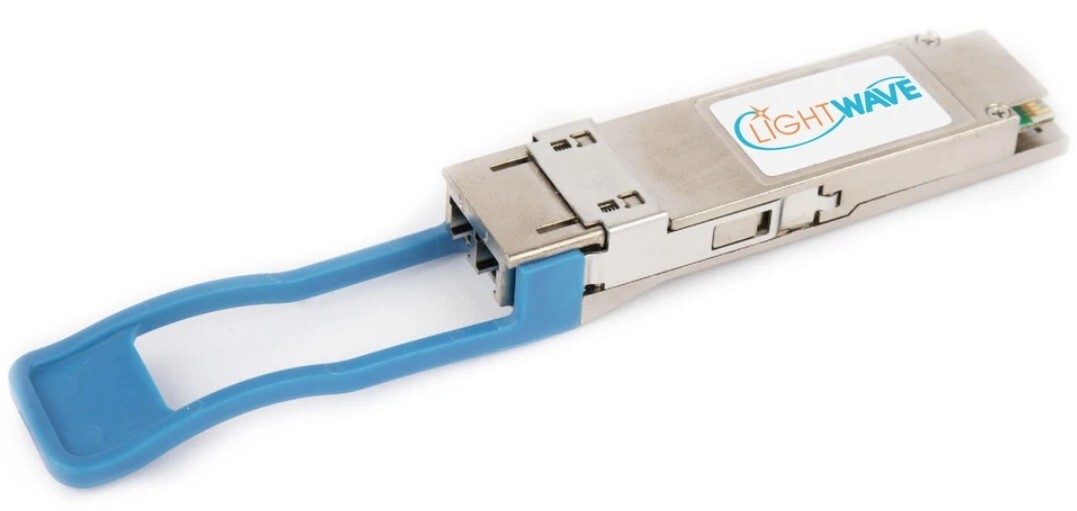
In 2006, Quad Small Form-Factor (QSFP) pluggable transceivers also hit the market. These transceivers support four lanes (channels), each operating at 1 Gb/s, for a total throughput of 4 Gig. They essentially serve as a high-density replacement for four single-channel SFP transceivers.
QSFP+ transceivers were then introduced to support four lanes at 10 Gb/s for a total throughput of 40 Gig. QSFP+ transceivers support 40 Gig over multimode fiber up to 150 m using parallel optical technology, which transmits data simultaneously over multiple fibers via MPO/MTP connectors. They also support up to 80 km over singlemode fiber using wavelength-division multiplexing (WDM) technology, which transmits data signals simultaneously over multiple wavelengths via duplex connectors. QSFP+ transceivers are commonly used in 4x10 Gig breakout applications for switch-to-server links, providing increased port density and cost efficiency.
QSFP+ Transceiver
High-Speed Transceivers
As signaling technology evolved and non-return-to-zero (NRZ) signaling reached a lane rate of 28 Gb/s, single-lane SFP28 transceivers for 25 Gig were introduced. While initially introduced for both twisted-pair copper and fiber applications, SFP28 transceivers never gained traction for 25GBASE-T copper applications due to 30 m distance limitations, high power consumption, and the expense of fully shielded cabling. Four-lane QSFP28 transceivers were later introduced for 100 Gig fiber applications.
When advanced PAM4 signaling came on the scene, doubling the NRZ rate to achieve a lane rate of 56 Gb/s, transceivers evolved to keep up, including the introduction of Double Density (DD) transceivers.
- Single-lane SFP56 transceivers for 50 Gig
- 4-lane QSFP56 transceivers for 200 Gig (4X50)
- Dual-lane SFP-DD transceiver for 50 Gig (2X25) or 100 Gig (2X50)
- 8-lane QSFP-DD transceiver for 400 Gig (8X50)
The QSFP-DD dominated the market for early 400 Gig deployments due to backward compatibility with QSFP ports. A competing 8-lane transceiver, the OSFP, was also introduced for 400 Gig. When PAM4 signaling advanced to a lane rate of 112 Gb/s, it paved the way for single-lane SFP112 transceivers for 100 Gig applications, dual-lane SFP-DD transceivers for 200 Gig (2X100), 4-lane QSFP112 for 400 Gig (4X100), and 8-lane QSFP-DD800 for 800 Gig (8X100) applications. The OSFP transceiver also evolved with the 8-lane OSFP800. Because the OSFP800 is slightly larger than the QSFP-DD800, it dissipates heat more effectively and has become popular for high-power AI and high-performance computing applications.
Because hot-pluggable transceivers allow network operators to easily adapt to evolving technology requirements without expensive forklift switch upgrades, they remain the interface of choice and continue to evolve. With PAM4 now advancing to a lane rate of 224 Gb/s, the QSFP-DD Multi-Source Agreement (MSA) has announced a QSFP-DD1600 pluggable transceiver that uses 8 lanes at 200 Gb/s for 1.6 Terabit applications, ensuring backward compatibility with QSFP-DD800 and QSFP-DD switch ports. The OSFP MSA also announced an 8-lane OSFP1600 transceiver for 1.6 Terabit.
How to Choose Your Transceiver
When choosing a transceiver, you will need to know the following criteria to select the right transceiver for your specific needs.
#1 Transmission Speed
Transmission speed is the primary specification that determines the transceiver form factor, which is based on the number of lanes and lane rate. The following table summarizes transceiver form factors and their maximum transmission speeds, ranging from 1 to 800 Gbps, based on the number of lanes and the maximum lane rate. The maximum distances for various media are also included, which vary by application.
|
Transceiver |
Max Speed |
# of Lanes |
Max Lane Rate |
Max Distance |
|
GBIC |
1 Gig |
1 |
1000 Mb/s |
100 m copper 550 m multimode 120 km singlemode |
|
SFP |
1 Gig |
1 |
1000 Mb/s |
100 m copper 550 m multimode 120 km singlemode |
|
QSFP |
4 Gig |
4 |
1000 Mb/s |
100 m copper 550 m multimode 120 km singlemode |
|
XENPAK |
10 Gig |
1 |
10 Gb/s |
100 m copper 400 m multimode 80 km singlemode |
|
X2 |
10 Gig |
1 |
10 Gb/s |
100 m copper 400 m multimode 80 km singlemode |
|
XFP |
10 Gig |
1 |
10 Gb/s |
100 m copper 400 m multimode 80 km singlemode |
|
SFP+ |
10 Gig |
1 |
10 Gb/s |
100 m copper 400 m multimode 80 km singlemode |
|
SFP28 |
25 Gig |
1 |
28 Gb/s |
100 m multimode 80 km singlemode |
|
QSFP+ |
40 Gig |
4 |
10 Gb/s |
150 m multimode 80 km singlemode |
|
SFP28-DD |
50 Gig |
2 |
28 Gb/s |
100 m multimode 80 km singlemode |
|
SFP56 |
50 Gig |
1 |
56 Gb/s |
100 m multimode 80 km singlemode |
|
QSFP28 |
100 Gig |
4 |
28 Gb/s |
100 m multimode 80 km singlemode |
|
SFP56-DD |
100 Gig |
2 |
56 Gb/s |
100 m multimode 80 km singlemode |
|
SFP112 |
100 Gig |
1 |
112 Gb/s |
100 m multimode 80 m singlemode |
|
SFP112-DD |
200 Gig |
2 |
112 Gb/s |
100 m multimode 80 km singlemode |
|
QSFP56 |
200 Gig |
4 |
56 Gb/s |
100 m multimode 80 km singlemode |
|
QSFP-DD |
400 Gig |
8 |
56 Gb/s |
100 m multimode 80 km singlemode |
|
OSFP |
400 Gig |
8 |
56 Gb/s |
100 m multimode 80 km singlemode |
|
QSFP112 |
400 Gig |
4 |
112 Gb/s |
100 m multimode 80 km singlemode |
|
QSFP-DD800 |
800 Gig |
8 |
112 Gb/s |
100 m multimode 80 km singlemode |
|
OSFP800 |
800 Gig |
8 |
112 Gb/s |
100 m multimode 80 km singlemode |
#2 Application
It’s important to understand that the internal circuitry of a transceiver varies by application, so you must choose a transceiver based on your specific application. A 4-lane QSFP+ transceiver that supports 40GBASE-SR4 multimode applications to 150 m, with 4 fibers transmitting and 4 receiving at 10G, will be internally very different from one that supports 40GBASE-LR4 WDM singlemode applications to 10 km, with 4 wavelengths on one fiber transmitting at 10 Gig and 4 on another fiber receiving at 10G.
In addition, if you’re planning to deploy breakout configurations, you will need to choose a transceiver that supports the application. For example, while a QSFP112 supports 400 Gig using four 112 Gb/s lanes, if you want to break a 400 Gig port out to eight 50 Gig connections, you will need an 8-lane QSFP-DD operating at a lane rate of 58 Gb/s.
#3 Connector Interface
Once you know your application, you also need to choose your transceiver based on the connector interface of your cabling infrastructure. Transceivers that support twisted-pair copper applications, such as 1000BASE-T and 10GBASE-T, all use the common RJ-45 interface. Parallel optical applications that transmit and receive over multiple fibers use multi-fiber push-on (MPO) connectors. In contrast, duplex, bidirectional and WDM applications that require only one or two fibers use simplex or duplex connectors, such as LC or SC connectors.
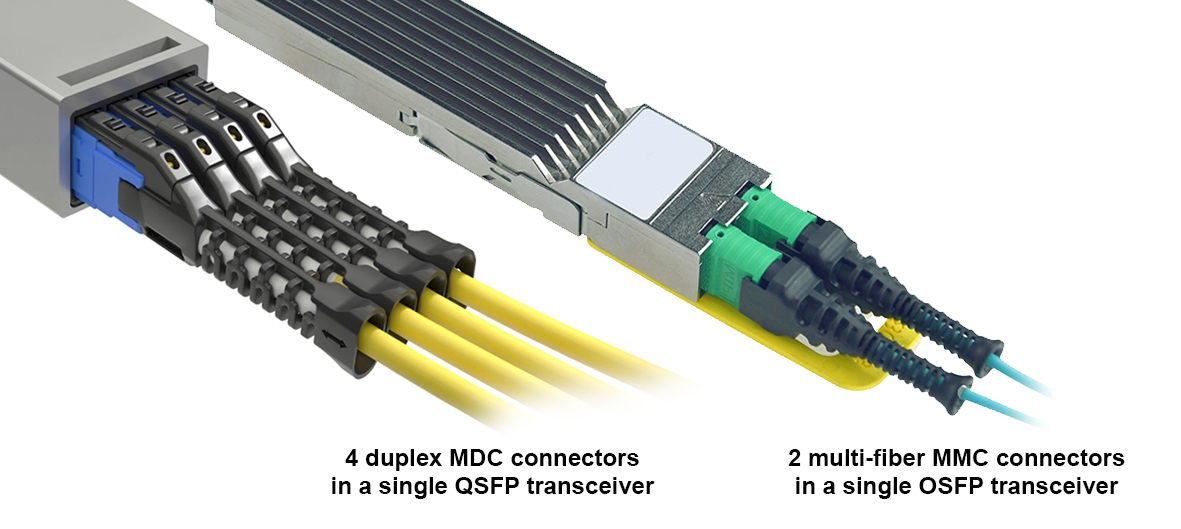
SFP, QSFP, and OSFP transceiver form factors also support newer very small form factor (VSFF) connectors, such as duplex CS, SN, and MDC connectors and multi-fiber SN-MT and MMC connectors. Due to their much smaller footprint, multiple VSFF connectors can fit within a single transceiver, supporting breakout links directly at the transceiver. For example, 2 or 4 VSFF connectors can fit into a single SFP-DD, QSFP-DD, or OSFP transceiver to support 2X25, 2X50, 2X100, 2X200, 2X400, 2X800, 4X25, 4X50, 4X100, 4X200, and 4X400 Gig breakouts.
#4 Equipment Compatibility
Another consideration is equipment. While transceivers can be generic and don’t need to come from the original equipment manufacturer (OEM), you want to make sure your transceivers are compatible with whichever vendor’s switches you’re planning to deploy—whether that’s Brocade, Cisco, Dell, Extreme, HP, or Juniper.
The good news is that Cables Plus USA offers a diverse line of networking transceivers for a variety of transmission speeds, applications, connector interfaces, and active equipment. Contact us today for help choosing your network transceivers.