
Ultra-Low Loss Fiber Connectivity: Why It Matters in Modern Data Centers
- Apr 2nd 2026


Insertion loss (also referred to as attenuation) is the amount of energy that a signal loses as it travels along a link. It is the primary parameter determining a fiber link's ability to support specific applications. Industry standards specify maximum loss and length for fiber links; exceeding these requirements can lead to increased bit error rates or total link failure.
As insertion-loss requirements for high-speed applications become increasingly stringent, ultra-low-loss fiber connectivity has become essential for reliable data transmission, manageable high-density environments, and the flexibility needed to scale data center architectures — all while providing headroom for inevitable installation variables and peace of mind. Let’s take a closer look at ultra-low-loss connectivity requirements and solutions for modern data centers.
Insertion Loss Budget Refresher
During the initial planning phase, data center designers determine a loss budget for each fiber link. The budget is the maximum permissible loss a link can incur based on industry standards and the output power and input sensitivity of the active electronics. They then calculate link loss based on the loss of each individual component in the link, including the cable and any connection points (connectors and splices). When comparing the loss budget to the calculated link loss, the goal is to ensure that the total link loss does not exceed the budget, while providing sufficient margin to accommodate losses from installation variables such as bends, contaminated connectors, and connector misalignments, as well as from aging transmitters over time.
Loss values vary by fiber type. OS2 singlemode fiber typically exhibits a loss of 0.4 dB/km at the 1310nm wavelength, whereas OM4 multimode fiber typically exhibits 3.0 dB/km at 850nm. A 25-meter singlemode link would have a loss of 0.01 dB, while a 500-meter link would have a loss of 0.2 dB.
Connector types also impact insertion loss. Simplex fiber connectors (and their duplex equivalents) typically have lower loss than multi-fiber MPO connectors due to the complexity of precisely aligning multiple fibers in an array. While industry standards specify a maximum mated-pair connector insertion loss of 0.75 dB, today’s connectivity offers significantly lower loss. Manufacturers use reference-grade terminations to accurately characterize and qualify the performance of their fiber components. It is worth noting that loss is specified for a pair of mated connectors, not a single connector. It’s actually impossible to calculate the loss of a single connector.
Various loss options are often available, including standard loss, low-loss, and ultra-low-loss. The following are common loss level ranges for duplex and MPO connectivity:
- Duplex LC Standard Loss: 0.35 dB – 0.75 dB
- Duplex LC Low Loss: 0.25 dB – 0.35 dB
- Duplex LC Ultra Low Loss: <0.25 dB
- MPO Standard Loss: 0.50 dB – 0.75 dB
- MPO Low Loss: 0.35 dB – 0.5 dB
- MPO Ultra Low Loss: <0.35 dB
Note that MPO-to-LC cassettes typically include the loss of both the MPO connection at the rear of the cassette and the loss of the LC connection at the front. A standard loss MPO-to-LC cassette would therefore range from 0.85 dB to 1.5 dB, while an ultra-low-loss cassette would have a loss of less than 0.6 dB. It’s also important to understand that not all MPOs are the same. MTP® connectors are a type of MPO that offer superior insertion loss due to their more precise end-face geometry and alignment. Click here to learn more about the difference between MTP and MPO.
Many manufacturers publish both maximum loss values and typical loss values for their connectivity. When calculating link loss, it’s best practice to use maximum loss values. While typical loss values reflect ideal conditions, they are not guaranteed. Using maximum loss values ensures a healthy margin to protect against real-world installation challenges. Even with careful insertion loss budgeting, testing the insertion loss of fiber links after installation with a fiber tester, such as an optical loss test set (OLTS), is essential to ensure support for specific applications. Plus, most specifications require insertion loss testing of the cable plant.
Increasingly Stringent Loss Requirements
Because insertion loss increases with transmission speed and distance, maximum loss and operating ranges for higher-speed applications have become increasingly stringent. For example, a 10 Gig OM4 multimode channel has a maximum loss of 2.9 dB with a maximum operating range of 400 meters, while a 400 Gig OM4 multimode channel has a maximum loss of 1.8 dB to just 100 meters.
Multimode applications have historically had more stringent loss and operating range requirements than singlemode. However, newer short-reach singlemode applications (DR at 500 meters and FR at 2000 meters), commonly deployed in the data center, now also face similar constraints. These applications rely on low-cost, low-power transceivers that operate with smaller power budgets and higher sensitivity to reflections that require more stringent loss requirements. Consider the contrast between a long-haul and a short-reach 400 Gig singlemode link. A 400 Gig ER long-reach singlemode link has a maximum loss of 18.0 dB to 40 kilometers, while a 400 Gig DR short-reach singlemode link has a maximum loss of just 3.0 dB to 500 meters. Short-reach VR multimode applications also have more stringent insertion loss requirements for the same reason.
The following table lists the maximum insertion loss values and operating ranges specified in industry standards for the most common multimode and singlemode data center applications. Note that insertion loss requirements become stricter with faster lane speeds enabled by advanced PAM4 signaling. In addition, higher-performing OM4 multimode has slightly less stringent requirements than OM3.
|
Multimode |
||||
|
Speed |
Application |
Lane Speed |
Max Insertion Loss (OM3/OM4) |
Operating Range (OM3/OM4) |
|
50 Gig |
50GBASE-SR |
50 Gb/s |
1.8 dB/1.9 dB |
70 m/100 m |
|
100 Gig |
100GBASE-SR4 |
25 Gb/s |
1.8 dB/1.9 dB |
70 m/100 m |
|
100 Gig |
100GBASE-SR |
100 Gb/s |
1.7 dB/1.8 dB |
60 m/100 m |
|
100 Gig |
100GBASE-VR |
100 Gb/s |
1.6 dB/1.7 dB |
30 m/50 m |
|
200 Gig |
200GBASE-SR4 |
50 Gb/s |
1.8 dB/1.9 dB |
70 m/100 m |
|
200 Gig |
200GBASE-SR2 |
100 Gb/s |
1.7 dB/1.8 dB |
60 m/100 m |
|
200 Gig |
200GBASE-VR2 |
100 Gb/s |
1.6 dB/1.7 dB |
30 m/50 m |
|
400 Gig |
400GBASE-SR8 |
50 Gb/s |
1.8 dB/1.9 dB |
70 m/100 m |
|
400 Gig |
400GBASE-SR4 |
100 Gb/s |
1.7 dB/1.8 dB |
60 m/100 m |
|
400 Gig |
400GBASE-VR4 |
100 Gb/s |
1.6 dB/1.7 dB |
30 m/50 m |
|
800 Gig |
800GBASE-SR8 |
100 Gb/s |
1.7 dB/1.8 dB |
60 m/100 m |
|
800 Gig |
800GBASE-VR8 |
100 Gb/s |
1.6 dB/1.7 dB |
30 m/50 m |
|
Singlemode |
||||
|
Speed |
Application |
Lane Speed |
Max Insertion Loss |
Operating Range |
|
50 Gig |
50GBASE-FR |
50 Gb/s |
4.0 dB |
2000 m |
|
100 Gig |
100GBASE-DR |
100 Gb/s |
3.0 dB |
500 m |
|
100 Gig |
100GBASE-FR |
100 Gb/s |
4.0 dB |
2000 m |
|
200 Gig |
200GBASE-DR4 |
50 Gb/s |
3.0 dB |
500 m |
|
200 Gig |
200GBASE-FR4 |
50 Gb/s |
4.0 dB |
2000 m |
|
400 Gig |
400GBASE-FR8 |
50 Gb/s |
4.0 dB |
2000 m |
|
400 Gig |
400GBASE-DR4 |
100 Gb/s |
3.0 dB |
500 m |
|
400 Gig |
400GBASE-FR8 |
50 Gb/s |
4.0 dB |
2000 m |
|
400 Gig |
400GBASE-FR4 |
100 Gb/s |
4.0 dB |
2000 m |
|
800 Gig |
400GBASE-DR8 |
100 Gb/s |
3.0 dB |
500 m |
|
800 Gig |
400GBASE-FR8 |
100 Gb/s |
4.0 dB |
2000 m |
In addition to the stringent insertion loss requirements of today’s high-speed data center applications, growing data center capacity demands and the rise of AI driven by massive numbers of interconnected high-performance GPUs have made fiber infrastructure denser and more complex. To keep up, networks must be manageable and scalable. Data centers rely on interconnects and cross-connects to create flexible patching areas between equipment. These patching areas facilitate cable management in complex, high-density environments while enabling flexible reconfigurations and faster deployments. To further accommodate density, these patching areas often also use very small form factor (VSFF) connectivity.
Unfortunately, patching areas introduce additional connection points in the fiber link, increasing overall insertion loss. The use of interconnects at both ends of a link for equipment connections with a separate cross-connect patching area adds four connections. In middle-of-row or end-of-row configurations commonly used in server clusters, a cross-connect in the network cabinet, with interconnect panels in each server cabinet, results in fiber links with three connectors. If the loss of these connection points is too high, it can exceed the total link budget, limiting the use of valuable patching and resulting in high-density fiber infrastructure that is difficult to manage and scale.
The Ultra-Low-Loss Advantage
There are several best practices during installation to help keep insertion loss down. For example, properly inspecting and cleaning any contaminated connector end faces is essential because dirty fiber end faces cause insertion loss. In addition, ensuring that cable bend radius and tension requirements are not exceeded can help keep overall loss down. However, with standard-loss and low-loss connectivity, these practices alone are often not enough to accommodate valuable patching areas between equipment while staying within maximum insertion-loss requirements and ensuring headroom. Ultra-low-loss connectivity is essential for supporting fiber patching without exceeding your loss budget.
Consider a 100GBASE-SR deployment using OM4 multimode fiber with a strict maximum insertion loss of 1.8dB. Using standard loss components may limit the number of connections in a channel to two, forcing you to eliminate patching areas and the use of high-density MPO-to-LC cassettes. In contrast, ultra-low-loss connectivity supports twice as many connectors to support patching areas and cassettes.
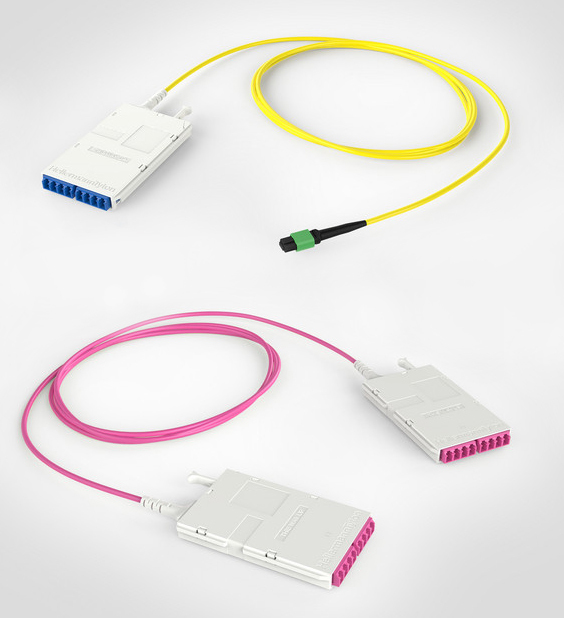 The good news is that Cables Plus USA now offers the HellermannTyton RapidNet ULTRA MTP pre-terminated fiber systems with best-in-class ultra-low-loss performance. With a maximum loss of just 0.25 dB for LC connectivity and 0.35 dB for MTP connectivity, and support for VSFF connectors, RapidNet ULTRA connectivity is designed to accommodate high-density fiber patching without exceeding maximum insertion loss requirements.
Available in both multimode and singlemode, RapidNet ULTRA tethered cassettes and cassette-to-cassette assemblies eliminate connection loss at the rear of the cassette, significantly improving loss performance. With a typical loss of just 0.25 dB, RapidNet ULTRA cassettes support high-density, flexible patching areas between active equipment while providing ample headroom to maintain signal integrity. These cassettes can be quickly installed directly into RapidNet ULTRA series housings, available in 1U, 2U, 3U, and 4U, and featuring integrated cable management and easy one-person installation.
Cables Plus USA is your trusted partner for high-performance fiber infrastructure deployments in the modern data center. Our full range of high-density MTP® solutions delivers the ultra-low-loss performance and superior density you need for manageable, flexible, and scalable networks, offering complete peace of mind. Contact us today to speak with a Cables Plus USA expert about your data center fiber needs.
EXPLORE OUR COMPLETE RANGE OF MTP HIGH-DENSITY DATA CENTER SOLUTIONS