

Upgrading K-12 School Networks for the Modern Classroom
- Apr 20th 2026

Across the country, K-12 school systems need to modernize their networks, which can no longer keep pace with learning technologies vital to student success in today’s digital world. This transition isn’t easy; districts must navigate inadequate infrastructure funding, IT staffing shortages, growing security concerns, and the challenge of integrating AI responsibly.
While high-speed fiber-optic and advanced copper cabling infrastructure are paramount to meet the demands of modern classrooms, strategic planning and execution are essential for ensuring highly scalable, future-proof infrastructure that reduces long-term operational costs and maximizes the network's lifespan.
Top IT Challenges for K-12 School Districts
To prepare students for a digital future, today’s K-12 schools are increasingly expected to support equitable one-device-per-student programs, remote and hybrid learning, and advanced technologies that boost student engagement and outcomes— everything from cloud-based adaptive learning platforms to immersive virtual reality and interactive gamification tools. Beyond the classroom, schools also require robust administrative and communication systems that reduce the burden on staff and ensure both physical and digital safety and security.
All of these requirements demand greater bandwidth, connectivity, and power. However, when it comes to upgrading K-12 networks, school districts face a set of challenges far more complex than those of a typical enterprise.
- Outdated legacy infrastructure: As schools move to 1:1 device models and adopt the latest Wi-Fi, audiovisual, security, and building automation technologies, legacy infrastructure can’t support the growing volume of devices – most of which require power over Ethernet (PoE). This bottleneck goes beyond frustration; it hinders innovation, efficiency, and cybersecurity.
- Aging and antiquated construction: Many K-12 school buildings are over 40 years old, with thick walls that make adequate Wi-Fi signal propagation impossible and limited equipment and pathway space that impede network upgrades and expansions.
- Geographically dispersed facilities: Districts often manage multi-building campuses spread across several miles. Connecting these sites and upgrading networks simultaneously across sprawling locations while maintaining consistency and availability is nearly impossible given the timing, staffing, and financial limitations schools face.
- Restrictive Timing Constraints: Upgrading K-12 networks requires careful coordination to align budget cycles, procurement, and installation with academic calendars. Major moves, adds, and changes must be executed during holiday breaks and summer vacations to minimize disruption.
- Financial constraints and funding gaps: With pandemic-era federal aid expiring, districts must navigate limited budgets and rising costs. To survive, schools must maximize E-Rate funds and state grants while shifting towards phased rollouts, equipment leasing, and pay-as-you-go cloud-based models with education-specific discounts.
- Staff shortages and lack of expertise: K-12 districts often lack the staff needed for technology integration and day-to-day IT support, while struggling with a lack of cybersecurity and AI skillsets. Tight budgets make it difficult to compete with the private sector for top-tier talent in an already depleted workforce.
A Strategic Decentralized Planning Approach
Most networks are designed using a traditional architecture that relies on multiple telecommunications rooms (TRs) distributed throughout a facility to support standard 100-meter copper links to devices. In a K-12 environment, this often necessitates extensive, long cable runs through hallways and ceiling plenums to every classroom, presenting several key challenges:
- Maintenance hurdles: Any move, add, or change requires technicians to access congested pathways, typically restricted to after-school hours and higher labor rates.
- Space limitations: Antiquated K-12 school pathways are often undersized to support the additional copper cables needed to connect the growing number of devices. At the same time, dedicated TRs consume valuable square footage that could otherwise be used for educational purposes.
- Thermal issues: As the demand for PoE increases, large cable bundles generate significant heat rise that can degrade transmission performance.
One strategic alternative for K-12 schools is a decentralized architecture that extends fiber-optic cabling closer to the network edge. In this model, fiber runs longer distances from a main equipment room to PoE switches housed in wall-mount cabinets. These cabinets act as “mini-TRs” that serve individual educational spaces or small clusters of classrooms. Wall-mount cabinets come in a variety of sizes and styles, including swing-out designs with hinged backs for easy access. They can be outfitted with cable management and fans for proper ventilation. They can be mounted near the ceiling, out of students' reach, and most feature lockable doors and side panels for added security.
Transitioning to a fiber-to-the-edge (FTTE) model using wall-mount cabinets eliminates the need for dedicated TR space and simplifies infrastructure management. Devices such as Wi-Fi access points, IP phones, digital displays, and surveillance cameras connect to nearby mini-TRs using short copper patch cables. This localized approach significantly reduces material and ensures that moves, adds, and changes are confined to smaller areas, eliminating the expense and inconvenience of dealing with long copper cables and waiting for school breaks to perform routine maintenance. With each mini-TR connected via a single lightweight fiber cable, pathway space limitations in older school buildings and heat buildup in large bundles of PoE-carrying cables are no longer a concern.
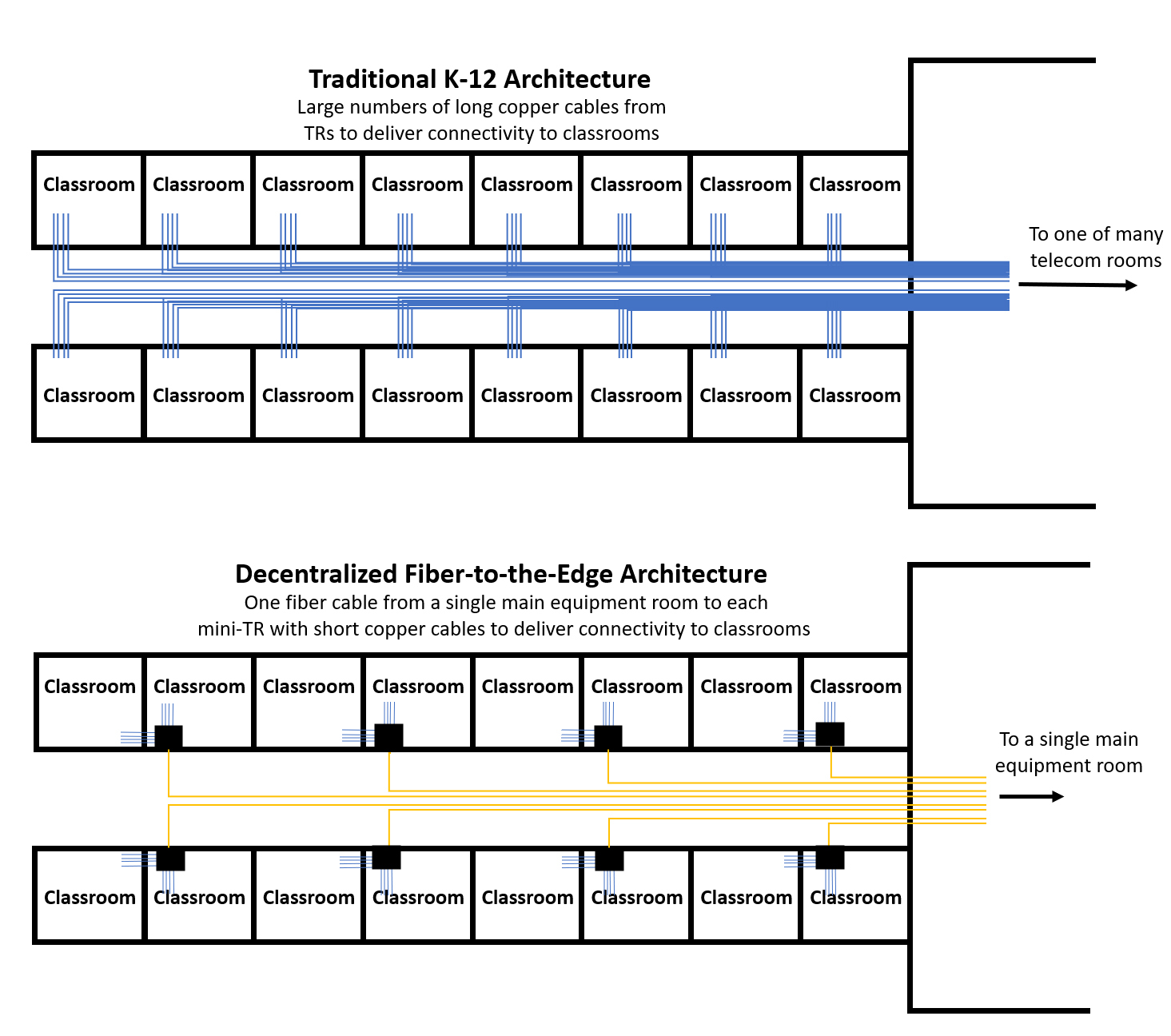
It’s important to note that a decentralized FTTE network typically qualifies for E-Rate funds. And because this approach reduces installation and maintenance time and costs, funds can go further, while reducing the burden on IT staff and leaving more time for skill development and strategic technology projects.
Ensuring Scalable, Future-Proofed Networks
In addition to easier maintenance and cost savings, a decentralized FTTE architecture simplifies the way K-12 schools build scalable, future-proof networks. By bringing fiber bandwidth closer to the network edge, schools can prevent data bottlenecks and eliminate physical pathway space limitations that can often hinder upgrades in traditional architectures. PoE switches housed in mini-TRs can also be sized to provide spare connectivity for future devices. For instance, while a single classroom typically requires only about 6 drops to meet today’s needs, installing a 24-port switch in a mini-TR serving two classrooms provides 12 spare ports to support future technology. Shorter copper links from the mini-TR also offer better signal headroom and easier cable management.
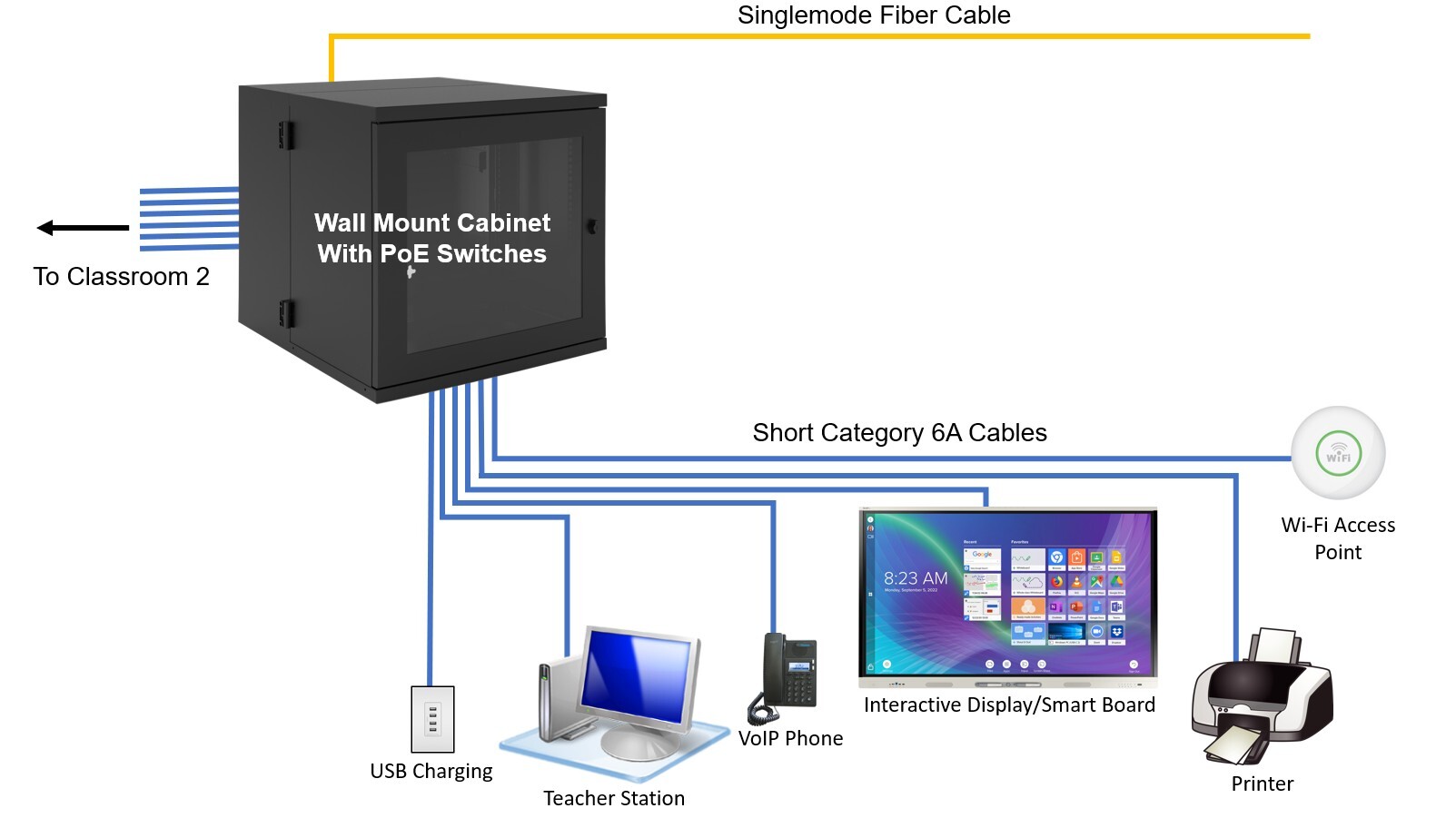
Regardless of the architecture, choosing the right cable media is essential for long-term scalability in K-12 schools. Premise backbone cabling to TRs or mini-TRs can use either singlemode or multimode fiber. While both support 100 Gig duplex uplinks, multimode is limited to 60 meters (OM3) or 100 meters (OM4). In contrast, singlemode can support up to 40 kilometers. For large schools using decentralized FTTE architecture, these distance capabilities allow every mini-TR to connect to a single main equipment room, eliminating the need to dedicate space to multiple full-size TRs.
For higher-bandwidth links, multimode relies on parallel optic technology that sends and receives at 100 Gig over multiple fibers, which requires increasing the number of fibers as speeds scale. For example, 200 Gig requires 4 multimode fibers while 400 Gig requires 8. Singlemode fiber, however, can support wavelength-division multiplexing (WDM), which enables sending and receiving data at 100 Gig over multiple wavelengths on a single fiber. This allows schools to leverage existing duplex singlemode fiber to migrate to higher speeds. In a decentralized FTTE architecture, deploying multiple strands of singlemode fiber to each mini-TR also maximizes the lifespan of a K-12 network for multiple decades.
For copper links that provide connectivity and PoE to devices, Category 6A cables are the modern standard. They deliver speeds up to 10 Gig, which easily support advanced Wi-Fi 6/6E, augmented and virtual reality, and digital displays in the modern classroom. These connections can be made with short copper patch cables available in a variety of colors for color-coding various applications and improving cable management. Category 6A also offers superior support for higher PoE levels due to its improved insertion loss and DC resistance. Furthermore, Category 6A is the minimum recommended horizontal copper cable for all new installations per TIA industry standards, including the ANSI/TIA-4966 Telecommunications Infrastructure Standard for Educational Facilities.
The good news is that Cables Plus USA is your trusted partner for K-12 network deployments, including those that use strategic decentralized FTTE architecture. Our full range of wall-mount cabinets, fiber-optic solutions, and copper connectivity includes everything you need to deliver highly scalable, future-proof infrastructure that supports today’s learning technologies, reduces long-term operational costs, and maximizes the lifespan of K-12 networks. Contact us today to speak with a Cables Plus USA expert about your K-12 projects.