
Top 5 Benefits of Fiber to the Desktop (FTTD)
- Nov 28th 2025

For decades, twisted-pair copper cabling has been the go-to standard for local area networks (LANs). But in today’s demanding digital landscape, copper has hit a wall.
With fiber becoming increasingly familiar and more cost-effective, fiber-to-the-desk (FTTD) is an unstoppable industry trend, driven by its intrinsic advantages that address all of copper’s shortcomings—bandwidth, reach, security, efficiency, and genuine future-proofing.
Let’s take a closer look at the key benefits driving FTTD adoption.
Unlimited Bandwidth Potential
Twisted-pair copper cabling has essentially peaked in the LAN at a maximum transmission speed of 10 Gig. Category 6A cabling, standardized in 2009, is characterized up to 500 MHz to support 10 Gig over 100 meters. Subsequent attempts to push copper beyond 10 Gig using higher frequencies proved impractical and costly — it required fully shielded cable construction, complicated installation, shorter link lengths, and power-hungry active equipment.
While 10 Gig is sufficient for most everyday business applications, technological advancements are requiring enterprises to transmit ever-increasing volumes of data. Applications such as virtual and augmented reality, high-end 3D animation, high-definition video processing, and advanced analytics are driving the need for greater bandwidth closer to the edge of the network. This demand is poised to accelerate as AI technology leads to even more data-intensive applications, requiring end devices to produce and uplink more data than ever before. Data generated at the edge is predicted to grow at a compound annual growth rate of 34% over the next few years, according to IDC’s Global DataSphere Forecast.
Fiber cabling offers a solution with virtually unlimited bandwidth potential. Fiber transmits data over pulses of light that travel significantly faster than electrical signals. It is also immune to electrical interference and signal degradation, which further limits bandwidth. In fiber systems, pulses of light can use different wavelengths on a single fiber via wavelength-division multiplexing (WDM), which dramatically increases bandwidth capacity. Currently, a duplex multimode fiber connection can support 10 times more bandwidth than copper over the same distance, and a duplex singlemode fiber connection can support 40 times more. As transceiver technology continues to advance, fiber’s bandwidth potential will only grow.
Reach Beyond 100 Meters
Twisted-pair copper cabling is limited to a maximum reach of about 100 meters from the switch in a telecom room to end devices. However, modern digital environments and the growing number of connected devices often require connectivity in remote and expansive locations that are frequently beyond the 100-meter limit. Deploying new telecom rooms to connect these distant devices occupies valuable space and is extremely costly, requiring additional equipment, cooling, power, labor, and maintenance.
Fiber optic cabling offers a cost-effective alternative for connecting devices beyond 100 meters, enabling more centralized equipment locations and fewer telecom spaces. OM4 and OM5 multimode fiber links can support 10 Gig up to five times the distance of copper, while singlemode fiber links can support 10 Gig up to 40 kilometers.
Inherently More Secure
Fiber is inherently more secure than traditional copper cabling due to several key factors related to its physical properties and network architecture.
Fiber does not radiate electromagnetic emissions, making it virtually impossible to tap without highly sophisticated equipment and direct physical access. In contrast, copper cables emit electromagnetic fields that allow eavesdroppers to capture radiated signals, often without physical contact or causing significant signal disruption, making intrusion difficult to detect.
When fiber is physically manipulated — even slightly — it alters the characteristics of the light signals. These minor anomalies can be easily detected to pinpoint the exact location of the physical disturbance. In fact, alarmed fiber solutions leverage this capability to detect anomalies along the entire length of a fiber. They can be used to establish NSTISSI 7003 protective distribution systems for secure pathways in sensitive government networks. In addition, fiber’s greater reach, which reduces the number of required telecom spaces, also means less physical space to secure and fewer switches that hackers can exploit.
Greater Efficiency and Sustainability
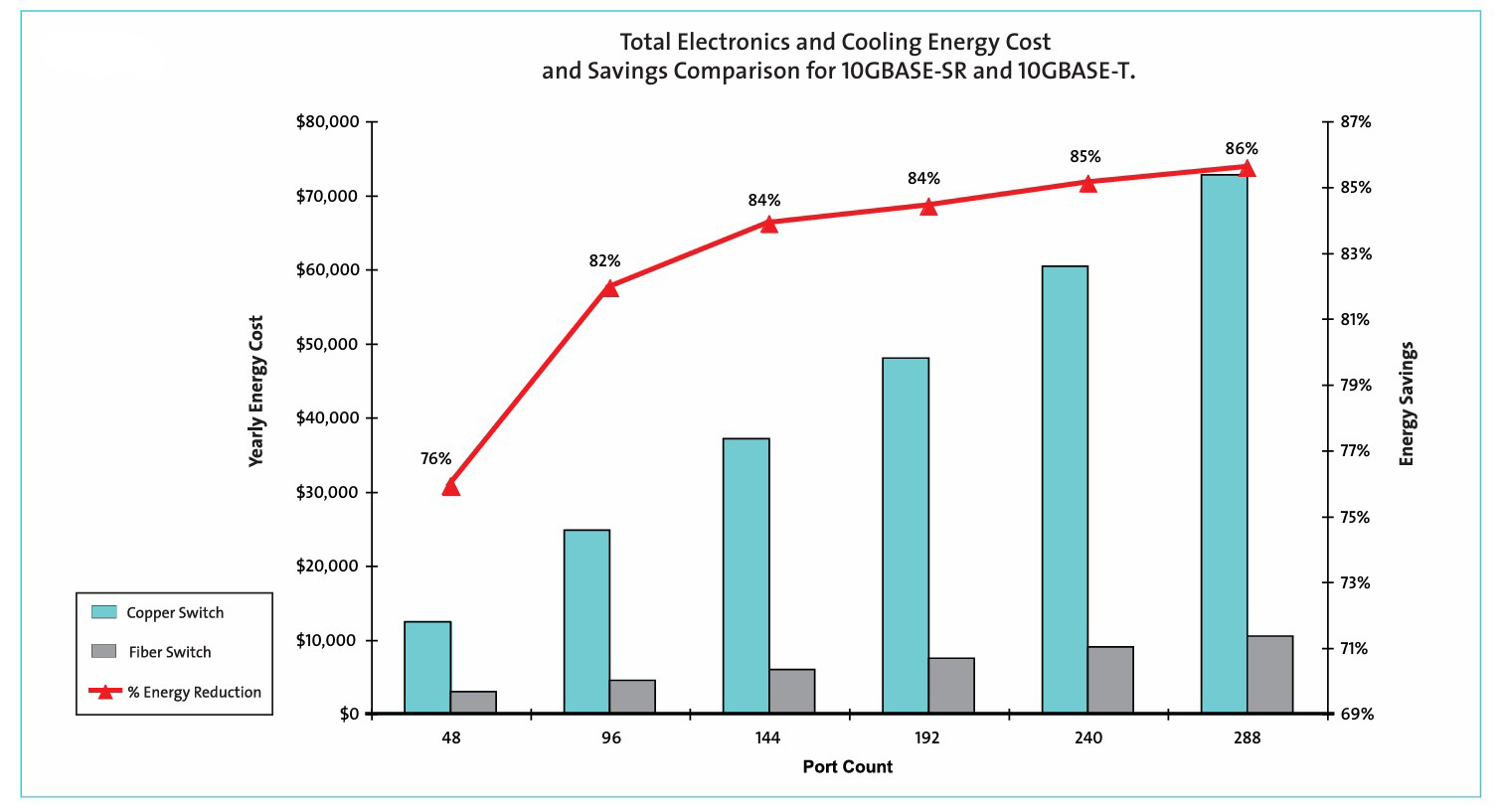
Fiber offers significant advantages over copper in terms of efficiency. Its greater reach requires fewer telecom spaces, which reduces operational maintenance and energy consumption for equipment, power, and cooling.
According to a Corning study, 10 Gig fiber links can deliver energy cost reductions of up to 85% compared to 10 Gig copper links, depending on the number of connections.
Fiber also significantly reduces overall material, space, and weight within a building compared to copper. Fiber cables weigh about one-tenth as much as copper cables and have a considerably smaller overall diameter. This offers improved density, reducing the number of racks, cabinets, and materials in telecom and pathway spaces. Smaller, lighter fiber results in lower overall installation costs and a lower carbon footprint.
It’s worth noting that fiber is considered a more sustainable technology than copper. The silicon dioxide used to make fiber is one of the most abundant materials on Earth, making up about 60% of the planet’s crust and 95% of its rocks. It’s also much easier to extract than copper with minimal environmental impact. On the other hand, copper is a finite material that requires complex, costly, and hazardous mining operations that heavily impact the environment. Studies show that manufacturing copper cables consumes up to 200 times more natural resources than manufacturing fiber.
Future-Proofing is Built In
Fiber’s virtually unlimited bandwidth potential eliminates the need for expensive, disruptive recabling as bandwidth demands increase. An optical LAN infrastructure can support multiple generations of active equipment upgrades without requiring new cable installation. In contrast, copper cabling infrastructure upgrades are typically needed as transmission speeds increase from 1 to 10 Gig. Plus, any requirement for speeds above 10 Gig immediately necessitates replacing the copper infrastructure with fiber.
Next-generation Wi-Fi clearly demonstrates this future-proof nature of fiber. To support maximum throughput, Wi-Fi 6/6E access points require at least two Category 6A copper connections, while Wi-Fi 7 requires four Category 6A copper connections. A single fiber connection supports all current and future Wi-Fi generations.
Fiber is also simply more durable and lasts longer than copper. Fiber offers greater pull tension during installation, simplifying installation and reducing the risk of damage and the need for costly replacements. Fiber is less susceptible to deterioration and corrosion from temperature, moisture, and electromagnetic currents. This reliability makes fiber the preferred medium for stable network connections in noisy and harsh industrial, medical, marine, and military environments.
While the upfront cost of fiber optic active equipment is typically higher than that of copper, FTTD provides significant long-term savings that outweigh the initial investment. When considering labor, materials, energy consumption, maintenance, and scalability, FTTD is the long-term winner — all while creating a more secure and efficient network.
The good news is that Cables Plus is your trusted partner for FTTD deployments. Our full range of fiber solutions includes everything you need for flexible fiber connectivity deployments in the LAN, including our new versatile, compact High-Density FTTD Enclosures — available loaded and ready to deploy. Contact us today to speak with a Cables Plus expert about your FTTD deployment.
EXPLORE OUR COMPLETE RANGE OF FIBER SOLUTIONS SPEAK TO AN EXPERT