

Avoiding Fiber Bend Radius Damage: 5 Tips for Long-Lasting Performance
- Apr 17th 2026
Despite being engineered from glass, fiber optic cabling is surprisingly durable. However, bending a fiber cable tighter than its minimum bend radius creates a risk of severe signal loss and micro-cracks that can trigger link failures and cause costly downtime. While the impact is not always immediately apparent, exceeding these limits can degrade fiber performance over time.
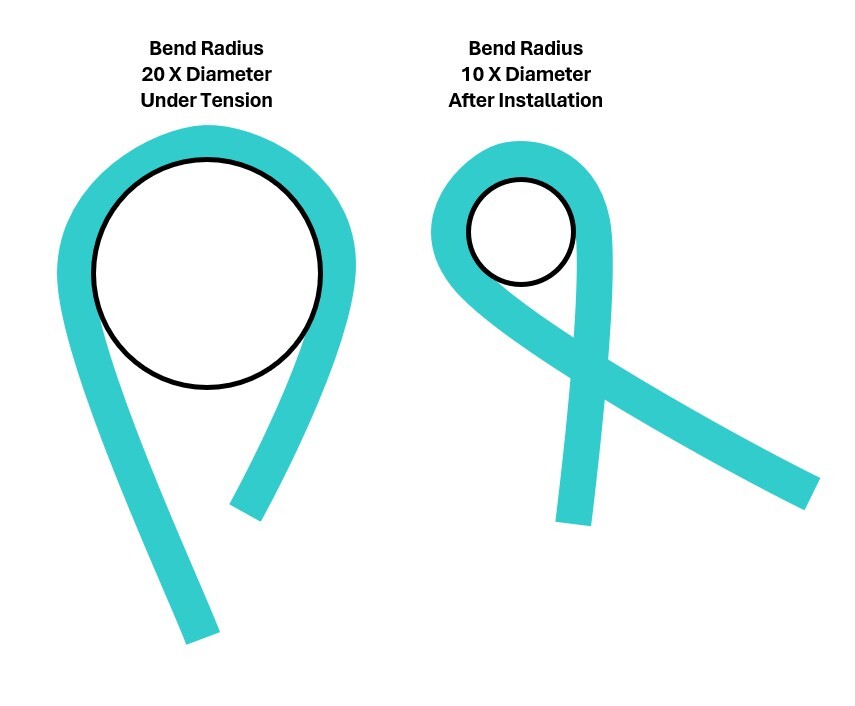
Standard fiber optic cables typically have a minimum bend radius of 20 times the cable diameter during installation, referred to as under-tension, under-load, or short-term. In contrast, the minimum bend radius is typically 15 times the diameter after installation for static long-term operation or storage. Because cables are under higher stress during installation, they require a larger, less flexible bend radius. A 6-fiber cable measuring 0.5 inches (13 mm) would therefore have a minimum bend radius of 10 inches (26 cm) during installation and 5 inches (13 cm) after installation.
Thankfully, with strategic pathway design and planning, fiber installation best practices, proper cable management, and modern fiber cabling solutions, bending fiber cable too tightly is entirely preventable. Here are five tips to keep your fiber network performing at its best.
Tip #1: Strategically Plan Your Fiber Pathways
There are several steps you can take in the early design phase to avoid exceeding the minimum bend radius. When planning fiber pathways between functional areas, avoid any 90-degree or less turns. Where changes in direction are necessary, design pathways with sweeping or gradual curves rather than abrupt angles.
Also, plan for ample pathway capacity. Industry standards recommend designing pathways with a maximum fill ratio of 40% to accommodate future cable requirements. While an eventual fill ratio of 70% is usually adequate, a higher ratio can lead to overcrowding in conduits, innerduct, or cable trays, causing cables to tangle and bend over one another.
Tip #2: Always Follow Best Installation Practices
To avoid exceeding the minimum bend radius during installation, always pull rather than push fiber cables through conduit. Avoid pulling fiber by the outer jacket or directly on the fiber itself — use fiber pulling eyes designed to apply tension to the internal strength members rather than the actual fiber strands. Cable reels are ideal for preventing twists and tangles, but make sure to carefully pay off the fiber as you go rather than spinning the reel.
During pulling, never exceed the manufacturer’s specified pulling tension. Whenever possible, complete the installation in a single, uniform pull rather than starting and stopping. If you must perform long horizontal runs, use a fiber-specific lubricant or a mid-span pull to prevent overstressing the fiber. Mid-span pulls involve setting up your cable reel in the center of the run, pulling one half of the cable to one end, pulling the remaining cable off the reel, laying it carefully on the ground in a large “figure-8” pattern, and then pulling the second half in the opposite direction. When installing fiber vertically, always pull down instead of up, and observe the maximum vertical rise distance limitations.
Temperature also impacts fiber installation. Always try to stay within the manufacturer's specified temperature range for installation. If installing in cold weather, fiber cables can stiffen, so increase the bend radius to prevent damage. In hot weather, reduce tension as cable jackets can weaken, especially when exposed to UV light.
When installing fiber, service loops are essential for future network expansion, maintenance, and repairs without replacing entire runs. As the saying goes, the most expensive fiber cable is the one that is too short. Most service loops range from 2 to 6 meters but may be longer for long runs or in locations with difficult access. When coiling, maintain a diameter of at least 5 inches and secure with Velcro, not zip ties, which can overtighten and damage the fibers. For larger service loops, use a figure 8 pattern.
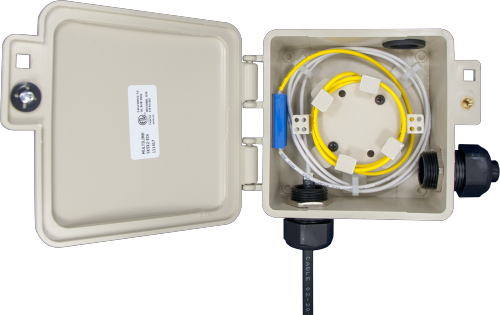
Service loops can be used anywhere in a fiber run, but are typically located at both ends of a permanent link. They are often stored in overhead cable trays, at the top of racks or cabinets, in underfloor pathways, or inside or behind enclosures or work area boxes. For outside plant installations, sealed slack storage boxes with integrated cable management to maintain bend radius are ideal for protecting service loops.
Tip #3: Use Dedicated Cable Management Solutions
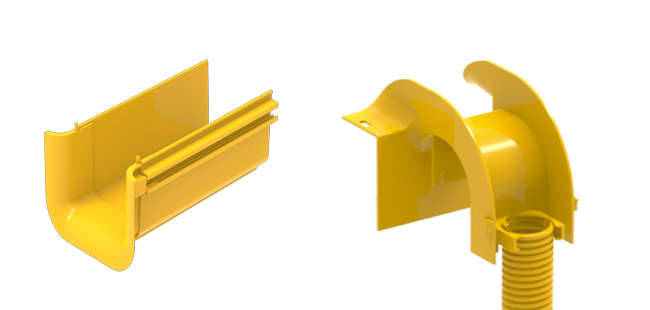
One of the best ways to avoid exceeding the fiber bend radius is to use a cable raceway designed specifically for fiber. Fiber duct systems with a range of straight channels, elbows, tees, and crosses are ideal for creating overhead pathways to route fiber between functional areas in the data center. These systems are designed to avoid sharp bends and maintain fiber bend radius. Where fiber exits the pathway, use drop kits or trumpet connectors to ensure a gradual transition. Cable radius drops should also be used with a traditional ladder rack runway to maintain the bend radius at drop points.
When choosing racks and cabinets, make sure they include support for vertical cable managers that organize the routing of fiber-optic cables to patch panels, switches, and other rack-mounted equipment. Vertical cable managers should offer easy cable access and include management fingers to support cables at each rack unit. To maintain the bend radius as fiber exits rack-mounted equipment, horizontal cable managers are a must-have.
Tip #4: Prioritize Enclosures with Integrated Support
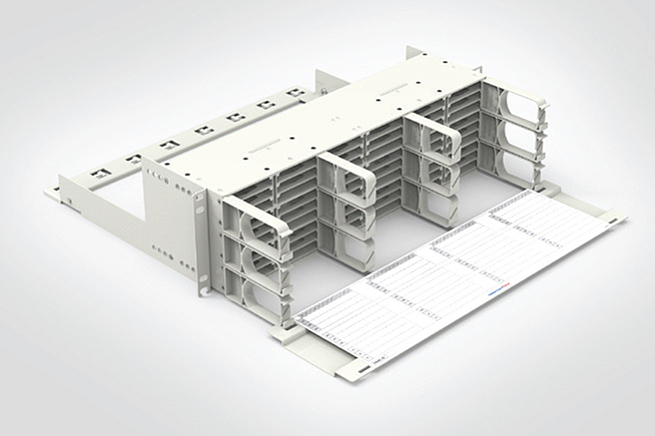
When selecting fiber enclosures, look for integrated cable management features — especially in high-density environments. Rack-mount enclosures should provide ample space for managing cables and offer easy front and rear access, with features like slide-out drawers, integrated strain relief, slack management, front management rings or fingers, and rear cable management support. The RapidNet ULTRA Series housings come standard with integrated rear cable management and front patch cord management rings.
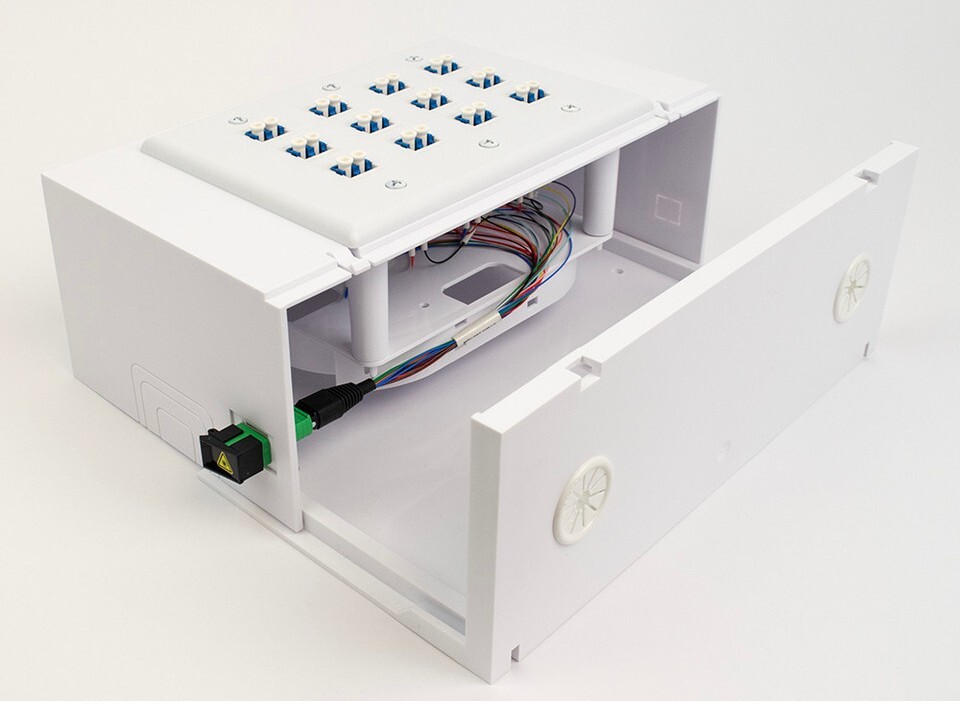
The same holds for any other type of fiber enclosure. Whether supporting fiber splicing, fiber-to-the-desk (FTTD), fiber distribution, or outside-plant fiber-to-the-home (FTTH) deployments, ensure that enclosures maintain fiber bend radius. Cables Plus USA’s high-density FTTD enclosure includes an internal spice tray and a fiber management structure that maintains proper bend radius while allowing slack fiber storage. Our wall-mount distribution enclosures all include built-in cable management spools, and splicing solutions are designed to maintain the proper bend radius for individual fibers.
Tip #5: Standardize on Bend-Insensitive Fiber
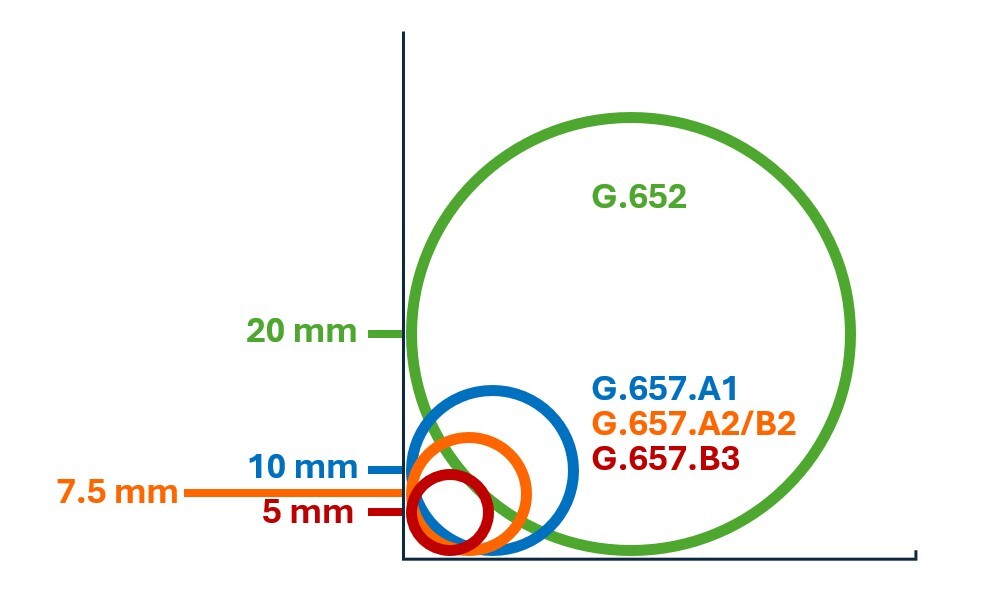
Because maintaining fiber bend radius is difficult in high-density environments such as data centers, central offices, and enclosures, consider bend-insensitive fiber. Sometimes referred to as bend-optimized fiber, bend-insensitive fiber incorporates a specialized ring or trench of material around the fiber core with a lower refractive index that keeps light contained even during tight bends. Rather than 20x/15x diameter rule, bend-insensitive fiber can be managed with a minimum bend radius of 15x/10x the diameter or less.
Introduced in 2007, singlemode fiber compliant to ITU G.657 standards is considered bend-insensitive compared to older G.652-compliant singlemode. Note that there are different levels of G.657 glass, with A1 offering a 10mm bend radius and specialty B3 offering a 5mm bend radius. Bend-insensitive multimode fiber, or BIMMF, was introduced in 2009.
While bend-insensitive fiber is less susceptible to signal loss and damage from bending, it’s still important to follow best practices for installation.
The good news is that Cables Plus USA uses bend-insensitive fiber as our standard, providing better flexibility and ensuring your fiber installations maintain optimal performance. This includes all of our HD8² high-density fiber cable assemblies and patch cords. We also offer bulk ITU G.657.A2/B2 singlemode fiber for installations requiring an even smaller minimum bend radius. Contact us today for all your fiber optic cable needs.